Homologated exhaust or not: does it pass the ITV (MOT) and can you get fined?
Find out if a non-homologated exhaust passes the ITV (technical inspection), the potential road fines for noise or missing DB killer, and how to know if your silencer is 100% legal.
Changing the motorcycle muffler is, probably, one of the first modifications every rider considers. Whether it's to improve aesthetics, reduce the overall weight, or achieve that throaty sound we love so much, the temptation to put on a new "exhaust tail" is always there. But let's get straight to the point and answer the two big questions that brought you here: does a non-homologated exhaust pass the technical inspection? No, absolutely not. Can you be fined on the road for having one? Yes, of course.
To avoid unpleasant surprises and headaches, you must understand that the relationship between a motorcycle ITV homologated exhaust is extremely strict. Environmental and noise pollution regulations have tightened significantly over the years. In this article, we are going to break down how to know if your exhaust is legal, when it is considered a major modification, what happens if you remove the DB killer, and what penalties you face if you decide to take the risk.
How to know if your motorcycle exhaust is legal and homologated?
Don't be fooled by appearances or by what a seller on a dubious website tells you. An exhaust is homologated for public road use only if it meets two fundamental and demonstrable requirements.
The first is the physical marking. Every legal exhaust must have the European homologation mark stamped or laser-engraved. This is identified by a capital "E" followed by a number (which indicates the country that issued the homologation, for example, 9 is Spain), all within a circle or rectangle, accompanied by an alphanumeric code.
The second requirement, and the one many forget, is that the exhaust must be homologated specifically for your motorcycle model. It is not enough to buy a universal muffler or adapt one from another brand. If you have doubts about how to face the inspection with full guarantees, we recommend taking a look at this prepare the motorcycle for the ITV. Along with the exhaust, the manufacturer must provide you with a paper certificate (the famous homologation card) indicating that the code engraved on the metal corresponds to your exact vehicle. Always keep that paper under the seat along with your documentation.
The maze of the motorcycle ITV homologated exhaust: When is it considered a modification?
This is where the theory gets complicated and where the dreaded Vehicle Modification Manual from the Ministry of Industry in Spain comes into play. The key is knowing which parts of the exhaust system you are modifying.
If you only change the final muffler (what is known as a slip-on) for a motorcycle ITV homologated exhaust for your specific model, it is not considered a major modification. According to the manual, the replacement of mufflers with other homologated ones does not require additional legalization, as long as the original noise and emission levels are maintained.
However, the story changes drastically if you decide to install a full system (headers, catalyst suppressor, and muffler). By eliminating the original catalyst, you are altering the vehicle's polluting emissions. This is considered a major modification. In these cases, to pass the inspection, you will need a technical project, a compliance report, and an assembly certificate. If you don't want to complicate your life, it is best to always go to professionals and search for shops and mechanical workshops where they can advise you before buying and install the parts according to the law.
DB Killer, "Racing" exhausts, and the dreaded sound level meter
What about those spectacular exhausts that say "For Racing Use Only"? As the name implies, they are exclusively for closed circuits. They do not have a European homologation code, they do not have sound restrictions, and if you show up with one of them at the technical inspection station, the result will be an immediate serious defect.
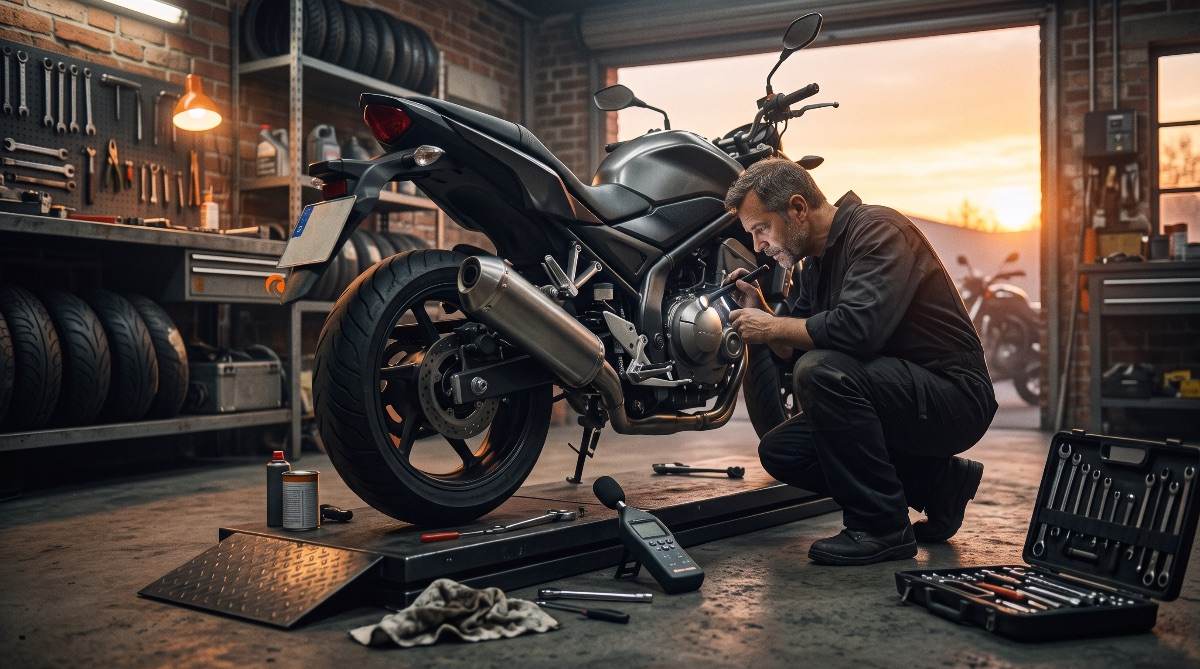
On the other hand, we have the issue of the DB Killer (the famous "pacifier" or sound attenuator). If your exhaust is legal and homologated, it is only so with the DB Killer installed. Removing this part automatically voids the homologation. When you go to pass the inspection, the technician will insert a probe or place a sound level meter half a meter from the exhaust at a 45-degree angle and rev the motorcycle.
The noise limit is specified on your motorcycle's chassis plate or in the technical data sheet (for example, 92 dB at 4,500 rpm). Current regulations allow a tolerance margin of +4 dB. If you exceed that threshold because your exhaust is modified, old, or missing the DB Killer, you will fail the inspection.
Road fines and legal problems
Driving with a free, non-homologated exhaust, or without the sound reducer is not only an administrative problem, but it also exposes you to the regulations of the General Vehicle Regulations. If you are stopped by the Civil Guard or the Local Police, the officers can sanction you for several reasons.
Generally, driving while exceeding the permitted noise limits or doing so with a component that lacks the mandatory homologation is considered a serious offense. Indicative fines usually range between 200 euros for excessive noise or unauthorized parts, and could even be higher or lead to the immobilization of the vehicle in cases of extreme acoustic disturbance that prevents civic coexistence.
It is essential to understand that a noise fine does not take points off your license, but it does affect your wallet. In the long run, between possible sanctions and extra parts, modifying the motorcycle poorly is expensive. You can do your own math with our maintenance cost calculator to see if the risk is really worth it. Also, if you want to be up to date on what traffic officers can demand, always review the regulations on motorcycle equipment.
Conclusion
Modifying the sound of your machine is a pleasure that every biker understands, whether you ride a modest scooter or need to perform the maintenance of a Yamaha MT-09. However, public roads have their rules. Make sure to purchase a product with its corresponding European certificate, do not remove the acoustic attenuator on the road, and always keep the documentation handy. Doing things right will ensure you enjoy every curve without the stress of looking in the rearview mirrors for a police checkpoint.
So that no paperwork is overlooked and you always ride with your documentation in order, activate ITV alerts in My Garage.
Este artículo y su imagen se han elaborado apoyándose en la inteligencia artificial y siendo revisados por el equipo de MotoCorner antes de publicarse. Las imágenes son ilustrativas y pueden no corresponder a modelos o piezas reales.