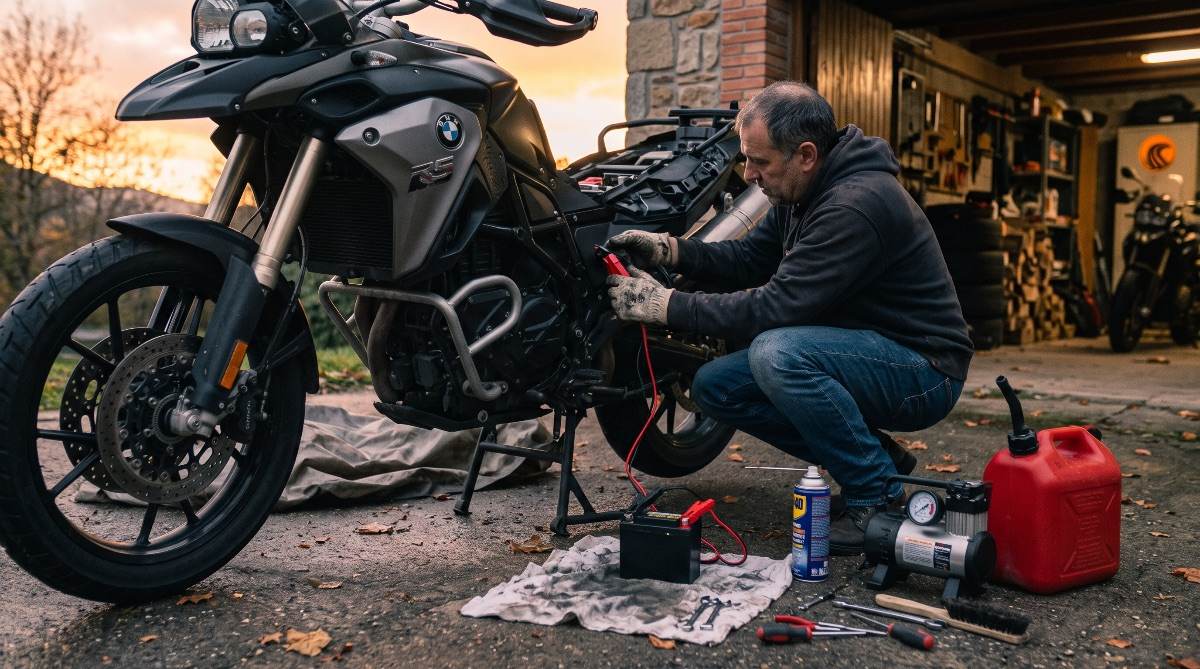
Storing your motorcycle for winter: how to leave it parked without any surprises
Discover the essential steps to winterize your motorcycle correctly. Protect the battery, tires, and engine so it starts on the first try when the good weather returns.
The real cold is arriving, along with the endless rains and that dreaded road salt that causes so much damage to metal components. Although we are very lucky with the weather in Spain and many bikers continue riding all year round, especially in the south or the east, in the north and the central plateau, sometimes there is no choice but to park the mount until the storm subsides. If you have made the decision to store your motorcycle for the winter, you should know that it is not enough to just leave it resting on the side stand and throw an old sheet over it. Leaving a vehicle stationary requires some preparation to avoid silent breakdowns.
An inactive motorcycle suffers almost as much as one that is ridden daily if the proper precautions are not taken. Fluids degrade, rubber deforms, and the electronics can play a nasty trick on you. Therefore, if you want it to start at the first hint of the button in the spring, it's time to do your homework.
Keys to storing your motorcycle for winter without surprises
The hibernation process of a motorcycle requires paying attention to several fronts. From the electrical supply to the contact with the ground. If you want to delve deeper into the overall care of your machine, we recommend visiting our section of articles on general maintenance to have a complete view of what your riding companion needs.
The battery: the Achilles' heel of the cold
If there is one component that hates low temperatures and inactivity, it is the battery. If you leave the motorcycle connected and stationary for two or three months, the most likely thing is that when you go to start it, you will only hear a sad click-click-click.
To avoid this, the best solution is to get an intelligent battery tender. These small devices connect to the power grid and the motorcycle's terminals, and they are responsible for supplying small pulses of energy only when the battery needs it, greatly extending its useful life. If your parking space does not have plugs nearby, the alternative is to disconnect the battery (always the negative terminal first) and take it home to a dry place at room temperature.
The fuel tank: full or empty?
This is one of the most classic debates. The general rule, especially if your tank is metal, is to leave it filled to the top. Why? Because where there is gasoline there is no air, and where there is no air there is no moisture condensation, which is the culprit for the inside of the tank rusting.
However, current gasoline contains ethanol, which tends to absorb moisture and degrade if it sits for a long time. The ideal is to add a fuel stabilizer liquid, fill the tank, and leave the motorcycle running for a few minutes so that this protective mixture reaches the injectors or carburetors. Be careful, some manufacturers recommend emptying the tank if it is made of plastic; when in doubt, always consult your model's manual. In the long run, understanding these small details is essential to know what extends the useful life in the garage and avoid premature visits to the workshop.
Tires and suspensions: avoid deformations
A 200-kilo motorcycle resting on the same point of the tire for weeks will end up deforming the casing, creating what is known as "flat spots" in the rubber. In addition, the suspensions suffer from supporting the weight asymmetrically (if you use the side stand).
The ideal is to put the motorcycle on stands (front and rear) or a center lift. This way, the wheels are in the air and the suspensions are relaxed. If you don't have stands, at least inflate the tires a little above the recommended pressure (for example, adding an extra 0.5 bar) and remember to move the motorcycle a few centimeters every couple of weeks to change the contact point. By the way, if you are worried about how these stops affect the longevity of the engine, you can discover what the real useful life in kilometers is depending on the treatment you give it.
Deep cleaning and breathable cover
Before putting your motorcycle to sleep, wash it thoroughly. Insect remains, tar, or brake pad dust are corrosive and will damage the paint and chrome if they remain embedded during the winter. After washing it, dry it perfectly, grease the chain, and apply silicone protective spray on the plastic and metal parts (avoiding brakes and tires). To finish the job like a professional, you can apply techniques of detailing and deep aesthetic maintenance.
Finally, cover it. But don't use bubble wrap or old sheets that accumulate dust. Invest in a specific motorcycle cover that is breathable; this way you will prevent moisture from the ground from getting trapped underneath and rusting the hardware.
Starting the motorcycle from time to time? The eternal debate
Many bikers have the habit of going down to the garage every two weeks and starting the motorcycle, leaving it idling for 5 or 10 minutes. Error. Starting the motorcycle just to let it run for a while at idle is harmful.
A cold engine runs on a mixture richer in gasoline, and combustion generates water. If the engine and exhaust system do not reach their optimal operating temperature (which does not happen just at idle), that water does not evaporate, generating condensation inside the exhaust pipe and contaminating the crankcase oil with moisture. If you are going to start the motorcycle, let it be to gear up and take it out for a ride for at least 20 or 30 minutes.
What to check when returning to action (De-hibernation)
When the first rays of spring sun arrive and the road calls you, don't just rush out onto the street. It's time to do the reverse process:
- Battery: Check that it has the correct charge and the terminals are tight.
- Tires: Readjust the pressure to that recommended by the manufacturer. Check the expiration date (the famous DOT) and make sure there are no cracks in the sidewalls.
- Brakes: Pump the levers and the pedal to check that the feel is firm and not spongy.
- Levels and leaks: Check the oil level, coolant, and brake fluid. Take a look at the floor under the motorcycle in case there is any suspicious stain.
Before going out to burn gasoline, check the key points of your motorcycle to ensure everything is in order. And if you prefer a professional mechanic to give it the go-ahead after so many months of being stopped, you can always take a look at how much a general service costs in Spain to be on the safe side.
Storing your motorcycle in winter doesn't have to be a drama if you follow these simple guidelines. Taking care of it while it is stationary is the best guarantee to enjoy safe curves when the heat returns. Note down the status in My Garage.
Este artículo y su imagen se han elaborado apoyándose en la inteligencia artificial y siendo revisados por el equipo de MotoCorner antes de publicarse. Las imágenes son ilustrativas y pueden no corresponder a modelos o piezas reales.