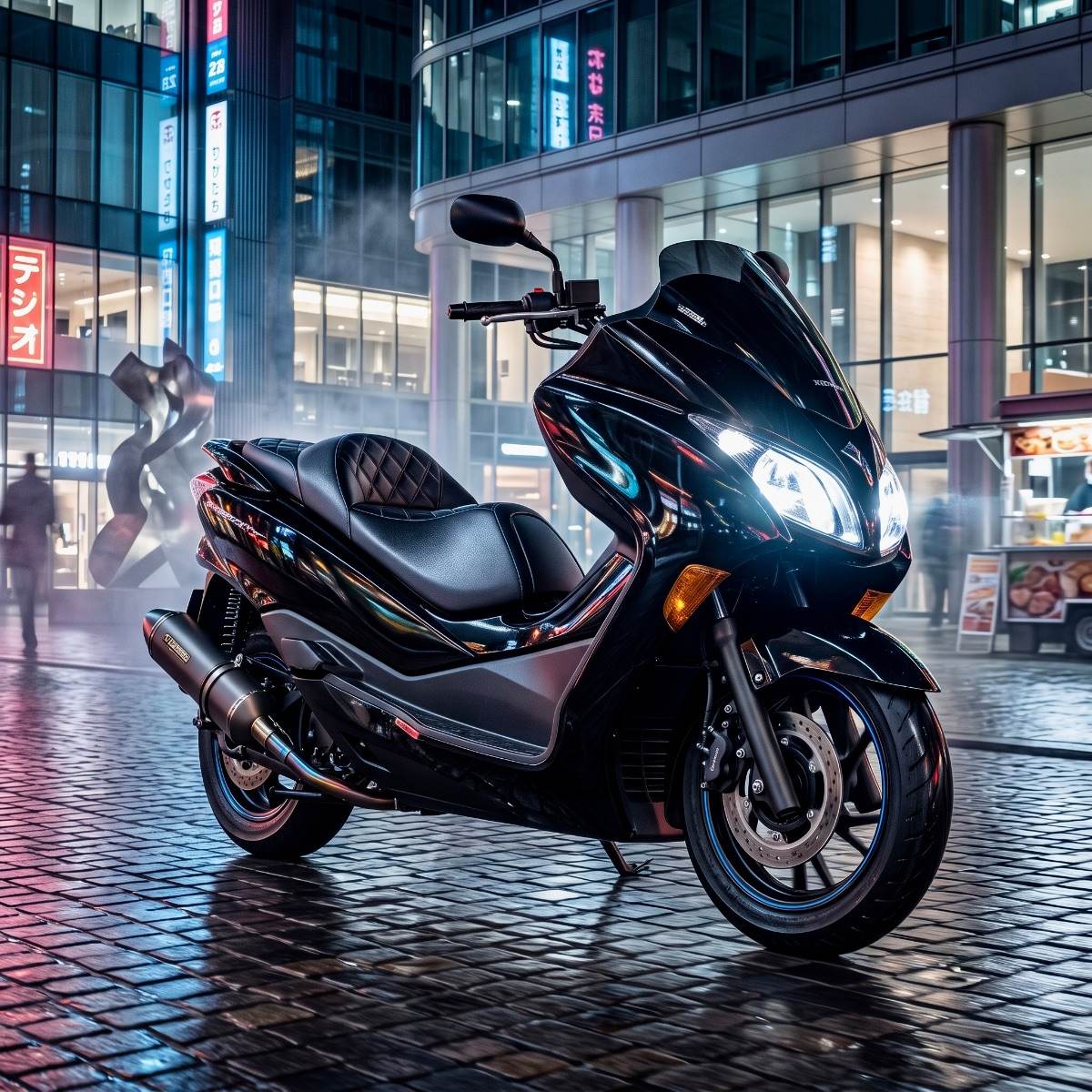
Official Honda Forza NSS250 (2006) Maintenance Guide: Checks and Intervals
Discover the complete maintenance plan for the 2006 Honda Forza NSS250. Mileage intervals, CVT belt check, oil control, and adjustments to keep your maxiscooter running like new.
The 2006 Honda Forza 250 (technical nomenclature NSS250) is one of the most beloved and reliable maxiscooters ever built by the Gold Wing firm. Its elegant aesthetics, outstanding cargo capacity, and smooth ride thanks to its electronic fuel injection (PGM-FI) made it the definitive urban and interurban commuter vehicle of its time. However, for a machine with a couple of decades behind it to continue performing like the first day, rigorous maintenance is the absolute key.
If you are thinking of acquiring this gem in the used motorcycle market or if it is already resting proudly in your possession, this technical guide is for you. We will break down the official intervals, the critical points of its mechanics, and the best tips to extend the service life of this robust single-cylinder engine.
Specifications and Recommended Fluids for the NSS250 (2006)
Before taking out the toolbox, it is essential to have the precise consumables and fluids specified by Honda in the workshop. Using inferior components in a maxi-scooter that frequently revs at high speeds on highways is a direct ticket to premature breakdown.
To maintain rigorous control of everything you change, we recommend adding your vehicle's data to your personal management area, where you can organize and record all dates, costs, and necessary upcoming checks.
- Engine oil: The factory specification requires SAE 10W-30 or 10W-40 oil, API SG quality standard or higher, and JASO MB certification (specific for scooters that have a dry centrifugal clutch). The capacity is around 1.1 liters when draining and increases to about 1.3 liters if disassembled for cleaning the internal strainer (note: this model does not have a conventional cartridge oil filter, but rather a washable metal strainer or mesh).
- Final transmission oil (Reduction gearbox): The manufacturer recommends using the same engine oil (10W-30 / 10W-40) for the final transmission, requiring a fill volume of just 0.3 liters after a complete drain.
- Spark plug: NGK CR7E (or alternatively Denso U22ESR-N). It is essential to check that the electrode gap is 0.7 to 0.8 mm.
- Coolant: Use ethylene glycol-based coolant (preferably high quality for aluminum engines and silicate-free), premixed at 50%.
Maintenance Plan by Mileage Intervals
Basic Inspections (Every 6,000 km or 6 months)
At this first threshold, your scooter requires purely routine but vital checks due to the nature of its lubrication system.
- Engine oil: Mandatory replacement. Given that the Forza only has a metal mesh screen that traps large impurities and the crankcase capacity is very low (a little over a liter), the oil suffers strong degradation due to thermal stress. Renewing the fluid frequently is the secret to the longevity of the NSS250 engine.
- Brakes: Visual inspection of pad wear. The 2006 Forza is usually equipped with the CBS (Combined Braking System). Check that the surface layer of the pads, both rear and front disc, maintains at least 1.5 mm of material in the wear area.
- Tires and Suspensions: Periodic check of the tread and adjustment of pressures. The recommended cold average indicates about 2.0 bar at the front and 2.25 to 2.50 bar at the rear, depending on the weight on the seat or top case.
To be able to manage progressive deterioration over time with rigorous criteria, also take a look at our analytical article on when to replace each vital spare part on your scooter, in order to anticipate the longevity of each component based on the years elapsed.
Intermediate Inspections (Every 12,000 km or 12 months)
Here we begin to fine-tune components that directly intervene in air intake performance, transmission force, and ignition quality.
- Oil screen: The cover housing the filter mesh in the lower engine must be removed, extracted, and scrupulously washed with assembly solvent. Always ensure you install a new O-ring seal to avoid sweating and unpredictable pressure leaks.
- Spark plug: Inspect condition, re-check the gap, and look for embedded carbon deposits; direct replacement is recommended in case of appreciable rounding on the ground or center electrode.
- Air filter: Inspect against direct light or replace with an OEM spare part. It is a paper component that, if ridden in environments with high pollution and urban particles, will normally be clogged and ready for the trash at 12,000 km.
- Final transmission oil: A check is usually decreed, but from a common-sense perspective, we suggest a mandatory preventive change. Simply drain completely through its bottom bolt and refill through the level bolt until it overflows.
- Crankcase breather: You must purge the small transparent blind tube or hose located just below or adjacent to the outer air box; it frequently tends to accumulate mixtures of moisture with traces of vaporized emulsion from the block.
Major Inspections (Every 24,000 km or 24 months)
The 24,000-kilometer inspection constitutes the most economically and mechanically heavy guideline of the pre-established service life cycle for the NSS series maxiscooter. By anticipating the necessary steps, you can obtain a detailed budget through our useful cost calculation tool which will guarantee a reliable advance notice and save you surprises when facing external maintenance.
- Transmission belt (CVT) and variator: The large V-belt that orchestrates the machine's progression withstands formidable thermomechanical stresses during continuous use; therefore, at 24,000 km, it is essential to replace it regardless of its apparent good condition. When removing the hermetic side cover to access the elastic band, it is time to meticulously check the calibrated rollers and guides. If the rollers show flat profiles, edges, or steps, the engine will rev very high but will be left without linear response during the entire urban takeoff.
- Valve clearance adjustment: It is totally and absolutely non-negotiable. Always check Honda's dictatorial clearance: Intake must measure 0.16 mm (± 0.02 mm) and the Exhaust area requires 0.22 mm (± 0.02 mm) using feeler gauges. As a liquid-cooled structural block with a single overhead camshaft head, it must be addressed strictly with the engine cold.
- Centrifugal clutch inspection: At this mileage, it will be imperative to observe the friction blocks or inner shoes to file or sand down possible glazing (very shiny thicknesses) on the facing surfaces inside the metal anchor bell, something that, when executed using a simple anti-grease brake cleaner spray, will resolve that agonizing and vibrating start at traffic lights.
Systemic Care of the Honda CBS and Anti-Aging Treatment
The powertrain and bodywork of this NSS250 range benefit from significant cycle advancements, such as its celebrated linked CBS braking architecture that distributes sequential bite from the levers. Over time, this complexity is a double-edged sword: the circuit becomes populated with rust flakes, retaining micro-bubbles of air. A deep bleed of the CBS environment requires methodical care and injecting fluid from the secondary valves through separate hoses, just as the original technical volume from Japan demands; otherwise, sponginess will take over the brake feel. If you do not have vacuum-controlled ball valves in your usual workspace, the wisest decision is decidedly to entrust its feel and integrity by consulting the best specialized mechanical workshops in the area where you reside.
Likewise, and in parallel to the benchmark mechanical purity, all the aesthetic plastic elements in the fairing will undoubtedly require continuous external hydration of their fibers to avoid cracking, which you will effectively achieve by relying on an exhaustive comprehensive detailing guide for used motorcycles aimed at protecting what the sun, after nearly twenty years of progressive UV punishment, has tried to crack after long stays under cover.
Conclusion
The 2006 iteration of the Honda Forza NSS250 remains a true marvel of durability in congested cities to this day. Vehicles with this same thermal configuration reach the coveted technical milestone of one hundred thousand kilometers without resorting to oversized cylinders with astonishing regularity, provided, of course, that you strictly adhere to the moral imperative of being diligent with oil changes every 6,000 km due to the small oil capacity and the simple strainer in the crankcase, invariably complementing this with the costly systematic renewal of the entire variator assembly every 24,000 kilometers as required. If you follow this demanding and structured log, you will continue to ride majestically alongside one of the most sublime and irreplaceable icons of the entire urban transit landscape. Protect its heartbeat, adjust your helmet, and let's ride!
Keep track of your motorcycle
Add your bike to My Garage for free: service, inspection and insurance reminders, with all your expenses in one place.
Sources and references
- ManufacturerManual de usuario y plan de mantenimiento oficial de Honda Forza NSS250
How we write this article
- We start from reliable documentation: manufacturer owner's manuals and maintenance schedules, official Spanish regulations (BOE and DGT) and public registration data.
- Artificial intelligence helps us organise and summarise that documentation. The text and image were produced with its support.
- Before publishing, the MotoCorner team checks the key figures (oils, pressures, intervals, legal requirements).
Images are illustrative and may not match real models or parts. Always check your motorcycle's manual.

Written and reviewed by
Ariel Cervantes
Founder of MotoCorner
A long-time motorcyclist, Ariel has ridden many different models and engine sizes. As MotoCorner’s founder, he combines his riding experience with his digital product background to coordinate and review maintenance guides, routes and tools for the motorcycle community.
Technical review: data checked against official manufacturer documentation and current regulations.