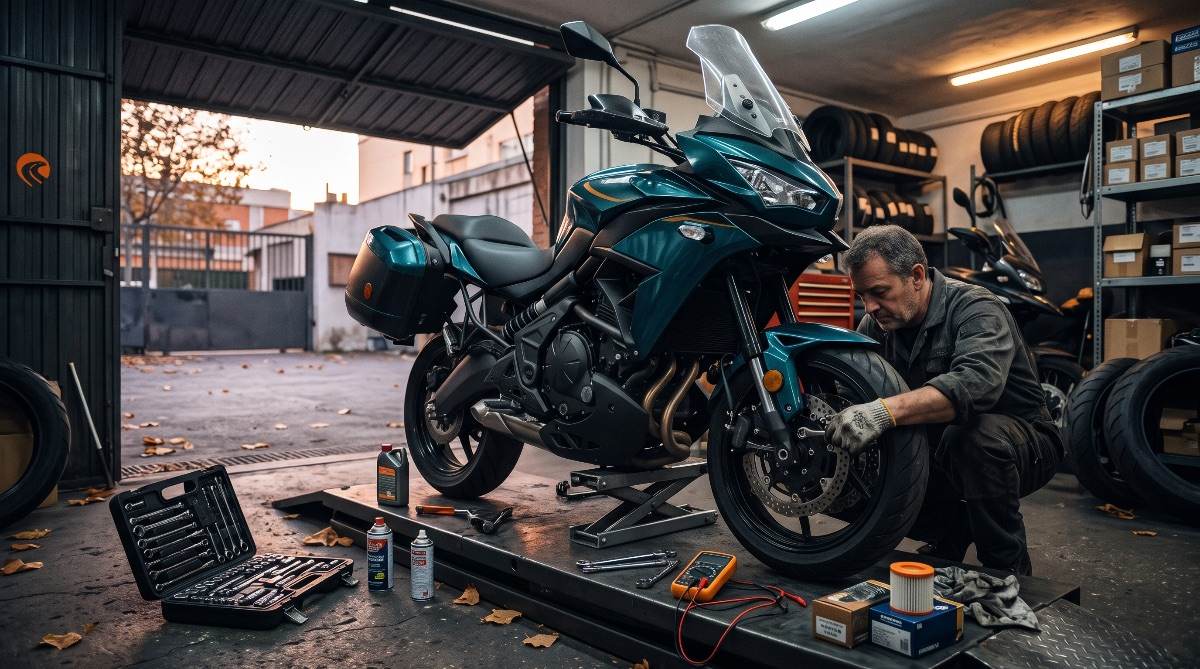
Kawasaki Versys 650 maintenance guide
Everything you need to know about Kawasaki Versys 650 maintenance. Learn about service intervals, consumables, tightening torques, and costs for your adventure-tourer.
If you have this tireless twin-cylinder trail-tourer in your garage, you already know it's one of the most logical, versatile, and fun bikes on the market. Its 649 cc engine is a true rock, but for it to keep devouring kilometers without complaint, strictly following the Kawasaki Versys 650 maintenance is completely non-negotiable.
This guide is primarily focused on the current generation and models from 2015 onwards (including the 2022 restyling with TFT screen and traction control). However, since it mechanically shares its excellent engine derived from the old ER-6, the vast majority of this data is applicable to previous versions.
Kawasaki Versys 650 maintenance plan: Service intervals
Kawasaki is known for manufacturing reliable mechanics with quite reasonable workshop intervals. Although it shares a philosophy with other best-sellers and it is interesting to compare it with the Yamaha MT-07 maintenance routine, you will notice that the Akashi brand has its own peculiarities, standing out for stretching the mileage quite a bit for heavy adjustments. Something very similar happens if you look at the brand's four-cylinder mechanics, such as the Kawasaki Z900 maintenance plan.
Here is the official summary of the key intervals:
- At 1,000 km (Break-in): The first vital step. The oil and oil filter are changed to remove metal shavings from the break-in period. In addition, chain slack and idle speed are checked, and a general tightening of the bolts is performed.
- Every 12,000 km or 1 year: Time for an engine oil change. Although Kawasaki indicates in some manuals that the filter can last longer, the general mechanical recommendation is to always replace the oil filter along with the lubricant. Brake pad wear, throttle body synchronization, and the clutch must be checked.
- Every 24,000 km: In addition to the annual service, the spark plugs and air filter are replaced. A clean filter is vital to keep fuel consumption in check on long routes.
- Every 42,000 km: The major service. This is when it's time to lift the valve cover to check and adjust the valve clearance. It is a fundamental intervention to avoid compression loss or serious damage to the valve seats.
- Fluids (Brake and Coolant): Brake fluid must be bled and replaced every 2 years, regardless of mileage. Coolant, on the other hand, lasts about 3 years or 36,000 km.
Capacities and recommended consumables
So you don't get lost looking for references when buying spare parts, here is the technical data extracted from the official workshop manuals. If you have doubts about wear symptoms, you can rely on our guide on when to replace motorcycle consumables.
- Engine oil: Kawasaki recommends an SAE 10W-40 that meets API SG, SH, SJ, SL, or SM and JASO MA, MA1, or MA2 standards.
- Oil capacity: Approximately 1.6 liters if you only change the oil, 1.8 liters if you also change the filter, and about 2.4 liters if the engine is completely dry after a rebuild.
- Oil filter: The most popular and reliable equivalent in the aftermarket industry is the Hiflofiltro HF303.
- Spark plugs: Use NGK CR9EIA-9. Remember that since it is a twin-cylinder, you only need two.
Key tasks in the garage: Chain and use with luggage
The Versys 650 invites you to travel, and that means loading it with side cases, a top case, and often, a passenger. This extra weight especially punishes the chain kit and the suspension.
Chain kit maintenance
The chain should be cleaned and lubricated approximately every 600 kilometers, or sooner if you have ridden in the rain. The correct chain slack (measured at the lower midpoint) should be between 25 and 35 mm. Checking this tension is crucial after loading the bike to the max for vacations.
Tire pressure and luggage
Don't gamble with pressures. The behavior of the 17-inch front wheel becomes clumsy if you are under-inflated.
- Solo use: 2.25 bar front and 2.50 bar rear.
- With passenger and/or luggage: Keep 2.25 bar at the front (or raise it slightly to 2.50 depending on the tire) but imperatively raise the rear to 2.90 bar to support the load without deforming the casing.
Important tightening torques
If you are going to perform the maintenance at home, a torque wrench is your best friend. Working by eye with the aluminum crankcase usually ends in disappointment. (Note: always confirm these values with the workshop manual for your specific year of manufacture).
- Oil drain plug: 30 Nm.
- Oil filter: 17 Nm.
- Front wheel axle: 108 Nm.
- Rear wheel axle: 108 Nm.
- Front brake caliper bolts: 34 Nm.
Indicative maintenance costs in Spain
The cost of maintaining a Versys 650 is one of its great attractions. It is a bike that is kind to your wallet if cared for correctly.
A basic annual service (oil, filter, and visual checks) at a trusted workshop usually costs between €120 and €180. If you don't feel like doing it yourself, we suggest looking for the best professionals in our directory of nearby motorcycle workshops.
For major services, such as the 42,000 km one which includes valve clearance adjustment, spark plugs, and coolant change, the bill will rise to the range of €350 - €550, depending on labor hours and whether it is necessary to replace calibrated shims in the valves.
To plan your biker budget well, we advise you to use our maintenance cost calculator, ideal for projecting your expenses throughout the year according to the routes you have planned.
Add your Kawasaki Versys 650 to My Garage and receive alerts for each service.
Lleva el control de tu moto
Guarda tu moto en Mi Garaje gratis: avisos de revisión, ITV y seguro, y todos tus gastos en un sitio.
This article and its image have been created with the support of artificial intelligence and reviewed by the MotoCorner team before publication. The images are illustrative and may not correspond to actual models or parts.

Escrito y revisado por
Ariel Cervantes
Fundador de MotoCorner
Motero desde hace años, ha rodado con modelos y cilindradas muy distintos. Fundador de MotoCorner, combina esa experiencia sobre la moto con su trayectoria en producto digital para coordinar y revisar las guías de mantenimiento, rutas y herramientas para la comunidad motera.