Buying workshop consumables for less: brake pads, oils, and spare parts
Learn how to negotiate with distributors, manage your stock of consumables, and optimize your workshop orders to improve your margins at the end of the month without compromising on quality.
Starting the month knowing that the numbers will add up is the peace of mind that every motorcycle workshop or dealership owner tirelessly pursues. However, daily operating expenses and inflation are tightening, and day-to-day consumables (oil jugs, brake pads, filters, hydraulic fluids, and spark plugs) take up a huge part of your monthly budget. If you are analyzing the market to know how to buy cheap workshop spare parts, you have come to the right place. It is not about skimping on the quality of the material you install for your customers at all, but about optimizing your purchasing processes so that every service and every repair leaves a healthier margin in your business.
In such a competitive environment, the profitability of a workshop no longer depends solely on mechanical expertise or having a full schedule; it depends largely on your skill in the office managing suppliers.
Strategies to buy cheap workshop spare parts and improve margins
For the income statement to be positive, you must understand that a euro saved on the purchase of material is a euro of direct and clean profit for your business. Below, we break down how to approach your supply strategy.
Local distributor, direct purchase, or purchasing groups?
One of the first strategic doubts is choosing who to buy the merchandise from. The local distributor or spare parts dealer usually offers an unbeatable advantage: immediacy. If you need specific pads to deliver a bike that same afternoon, they save the day. The downside? The intermediation margin they keep makes your acquisition cost higher.
On the other hand, direct purchase from the brand itself or from large national and international importers drastically reduces the unit cost of the product, allowing you to access much more attractive net rates. However, this route usually requires high purchase volumes or annual billing commitments that not all workshops can assume on their own.
This is where a third, very intelligent path comes into play: purchasing groups or central purchasing offices. Joining a workshop association allows you to add your order volume to that of other colleagues in the sector. In this way, you can negotiate rates and rebates as if you were a large chain of dealerships, obtaining discounts that would be unattainable individually.
Volume, minimum orders, and payment terms
When sitting down to negotiate, do not look only at the unit price of the spare part; logistical and financial conditions matter just as much or more. An excellent price is ruined if you have to pay shipping costs for every small shipment. Evaluate whether it pays to group purchases to always reach the minimum factory-gate order (without shipping costs). Especially if you are going to prepare the campaign calendar for your motorcycle shop, anticipating the high volume ensures you don't run out of material and get the best deal.
Likewise, cash flow is the lifeblood of your business. Negotiating payment terms with your consumables supplier is vital. Moving from cash payment to standard commercial installments gives you essential treasury oxygen to operate. Projecting your spending on consumables for the next quarter is fundamental to sitting down to negotiate with your suppliers by demonstrating a stable purchasing horizon.
Minimum stock vs. daily order: The balance of profitability
Having your warehouse shelves full of slow-moving consumables is synonymous with having immobilized money gathering dust. On the contrary, the extreme policy of "daily ordering" (ordering only when the bike is already on the lift) severely penalizes your margin due to recurring shipping costs and the loss of discount scales.
The key to success lies in deeply analyzing your repair orders. Apply an ABC management model: "A" products are those you use daily (10W40 oil, standard brake fluid, universal oil filters). These are the ones that should make up your minimum safety stock and the ones you should buy in large volume taking advantage of the best offers. For rare or specific material ("C" products), it does make sense to resort to on-demand ordering.
If your workshop also handles reconditioning vehicles for sale, you will know that performing good maintenance and detailing for second-hand motorcycles requires chemical products and supplies that you use by the liter, so planning their purchase in industrial jugs rather than retail formats will radically change your operating costs.
Remember that if you adjust your internal costs efficiently, you will have more room for maneuver to offer attractive rates or to absorb price increases without passing them on to the end user all at once. We recommend analyzing the general situation in our article on how much a motorcycle service costs in Spain to understand where your rate is positioned relative to the market.
The value of our professional network at MotoCorner
Knowing the market and knowing who to collaborate with is an essential part of success. At MotoCorner, we boost business visibility and professional networking. Working on your presence and your Local SEO for workshops ensures that customers find you, but knowing your colleagues in the sector ensures you stay up to date on business strategies. In our interactive ecosystem, such as the biker forum, you can share real opinions on which suppliers provide the best after-sales service.
Within our directory, we have a huge network of professionals who operate under different and successful business models. You can locate and collaborate with all these businesses using our shop and workshop search engine.
Review what you consume most in the workshop this week and compare conditions calmly: every point of margin you gain on purchases is noticeable at the end of the month.
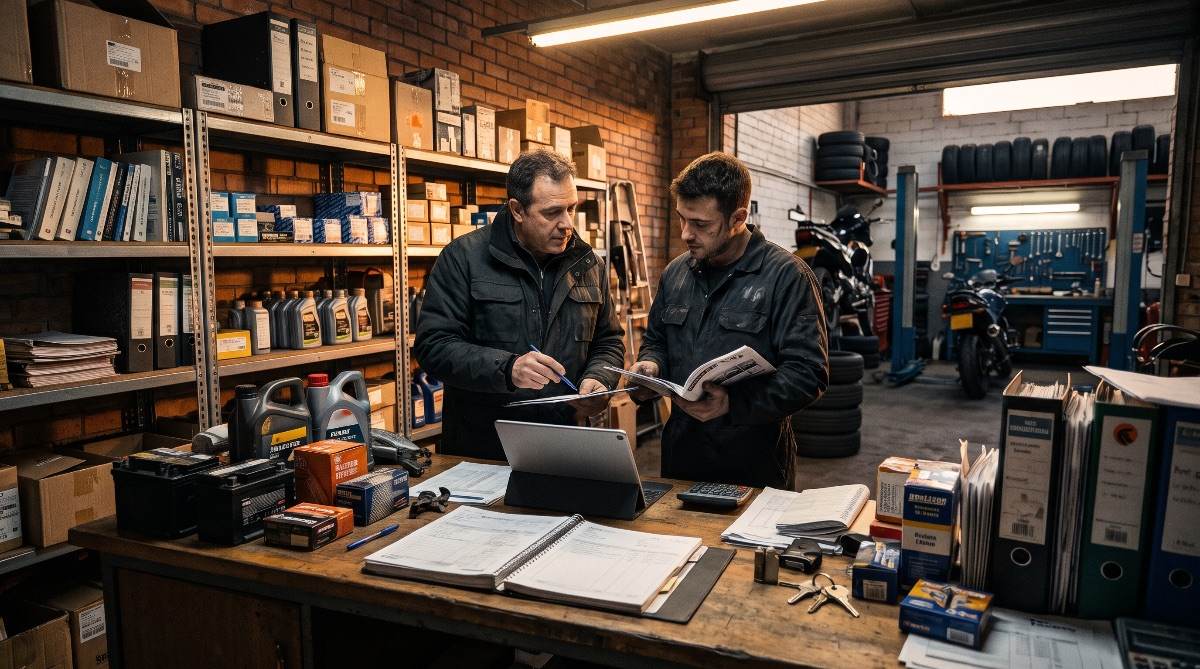
This article and its image have been created with the support of artificial intelligence and reviewed by the MotoCorner team before publication. The images are illustrative and may not correspond to actual models or parts.

Escrito y revisado por
Ariel Cervantes
Fundador de MotoCorner
Motero desde hace años, ha rodado con modelos y cilindradas muy distintos. Fundador de MotoCorner, combina esa experiencia sobre la moto con su trayectoria en producto digital para coordinar y revisar las guías de mantenimiento, rutas y herramientas para la comunidad motera.