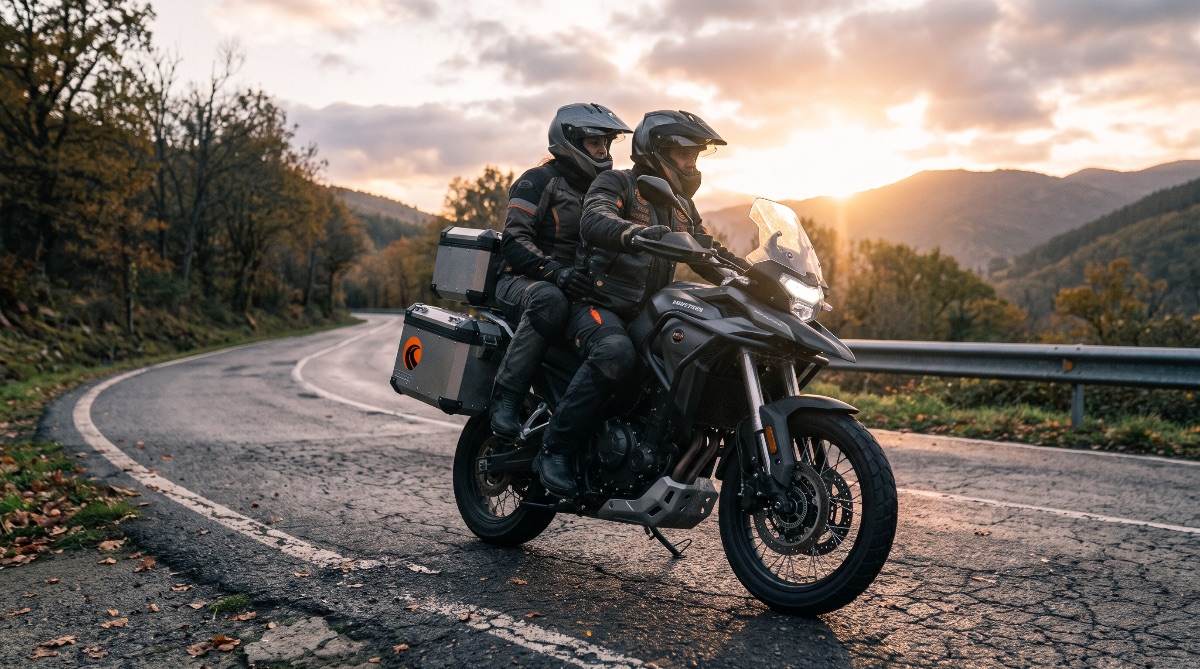
Riding with a passenger: tips for riding two-up safely
Discover the best tips for riding two-up on your getaways: suspension settings, tires, mandatory gear, and techniques to enjoy the route in company.
Autumn long weekends and the first winter getaways have a special charm. The roads are tinged with reddish colors, the air is fresher, and the landscapes invite you to share them. However, going on a route with a passenger completely changes the dynamics of your machine. Carrying a passenger on a motorcycle is a huge responsibility that requires adapting both the mechanics of your mount and your riding technique. It’s not just about your companion (affectionately known as a "pillion") being comfortable, but about ensuring safety and stability at all times.
If you are planning to share your seat on your next outings, in this article we tell you everything you need to know: from how to adjust pressures and suspension, to the protocol for getting on and off, or how to communicate while riding. Get ready to turn every duo route into an unforgettable experience.
Mechanical adjustments before carrying a passenger on a motorcycle
When adding the extra 60, 70, or 80 kilos of a companion (plus any potential luggage), the geometry and dynamic behavior of your motorcycle change drastically. The rear end drops, the steering lightens, and braking requires more distance. Therefore, before starting, there are two non-negotiable adjustments you must make.
Shock absorber preload adjustment
To compensate for the extra weight on the rear axle, you must stiffen the suspension. On most motorcycles, this is done by increasing the rear shock preload. If you don't do this, the motorcycle will bottom out on bumps, the headlight will dazzle oncoming cars, and you will lose feel in the front wheel.
There is no universal magic number; the ideal is to consult your model's manual to know how many "clicks" or turns you should add. If you usually keep a record of these adjustments, it will be very useful to manage maintenance in My Garage to always have your motorcycle's ideal parameters at hand.
Tire pressure
The rear tire will support a much greater load. As a general rule, manufacturers recommend increasing the rear tire pressure in an indicative range of between 0.2 and 0.3 bar when riding as a duo, although you should always stick to what is indicated on the swingarm sticker or the user manual. Take the opportunity to check your motorcycle tires in autumn, verifying that the tread and rubber are in perfect condition to evacuate water or deal with cold asphalt.
To make sure you don't miss anything, we recommend reviewing our pre-trip inspection checklist.
Passenger gear: safety is a two-person job
One of the most common (and dangerous) mistakes is seeing a rider equipped to the teeth with leather, armor, and a high-end helmet, while the passenger wears jeans, canvas sneakers, and a street jacket. The asphalt does not distinguish between the one in front and the one behind.
Your companion must be just as protected as you are. This includes a homologated helmet of their size (don't lend them one that is too big), a jacket with armor, abrasion-resistant gloves, specific pants, and motorcycle footwear. In addition, we advise you to be up to date with the DGT regulations on equipment to avoid legal surprises and, above all, to ensure maximum safety. If you want to go a step further in protection, equipping your passenger with one of the new latest generation motorcycle airbags is an investment that is priceless.
Also remember that in autumn and winter, the passenger suffers more from the cold than the rider, as they are not as physically active and receive air turbulence. Thermal layers are essential.
How to get on and off the motorcycle with elegance (and without falling)
The stationary drop is the classic accident when riding as a duo. To avoid it, the protocol must be clear and strict:
- The rider is in charge: The passenger should never try to get on or off without the rider's "OK."
- Rider posture: You must have both feet firmly planted on the ground, the motorcycle upright, first gear engaged, and the front brake lever squeezed hard.
- The ascent: The passenger approaches from the left side, places their hand on the rider's shoulder, puts their left foot on the footpeg, and pushes themselves up, swinging their right leg over the seat.
- The descent: It is done exactly in reverse, always waiting for the rider's confirmation.
Duo riding: smoothness and anticipation
When you have a passenger, your riding style must transform. Forget about abrupt acceleration and late braking; the keyword here is fluidity.
The dreaded helmet clashing
If you hear a "clack!" behind you when braking or changing gears, it means the helmets have hit each other. This happens due to a lack of smoothness. By carrying more weight, inertia is multiplied. You must anticipate braking, using the rear brake more than usual (since it now has more weight and grip) and release the clutch much more gently when shifting up or down.
Cornering
The passenger should be like a backpack: they should neither try to hang off like a MotoGP rider nor get scared and lean in the opposite direction of the turn (the latter is extremely dangerous). The golden rule for the companion is simple: they should look at the curve over the rider's shoulder that corresponds to the inside of the turn. If the turn is to the right, they should look over your right shoulder. This way, their body will naturally follow the lean.
Communication and stops on the route
Intercoms have revolutionized duo travel, allowing you to chat, warn about bumps, or comment on the landscape. However, technology can fail, so it is vital to establish a code of physical signals before leaving. For example:
- A tap on the right leg: "I need to stop."
- Two taps: "Go slower."
- Thumbs up: "Everything is fine."
Finally, keep in mind that the passenger gets tired sooner. Their posture is usually more static and their knees are more flexed. Plan routes with more frequent breaks. Take the opportunity to discover the best biker bars and legendary stops where you can stretch your legs and have a hot coffee.
Riding as a duo is one of the most beautiful experiences that motorcycling offers. With the bike ready, the right gear, and smooth riding, your companion will be looking forward to doing it again. Plan a duo route on A Rodar and enjoy the road together.
This article and its image have been created with the support of artificial intelligence and reviewed by the MotoCorner team before publication. The images are illustrative and may not correspond to actual models or parts.

Escrito y revisado por
Ariel Cervantes
Fundador de MotoCorner
Motero desde hace años, ha rodado con modelos y cilindradas muy distintos. Fundador de MotoCorner, combina esa experiencia sobre la moto con su trayectoria en producto digital para coordinar y revisar las guías de mantenimiento, rutas y herramientas para la comunidad motera.