LED turn signals on your motorcycle: which ones are legal and which ones will make you fail your ITV
Discover the requirements LED turn signals must meet to pass the ITV (MOT) without issues. European homologation, relays, legal distances, and how to avoid traffic fines.
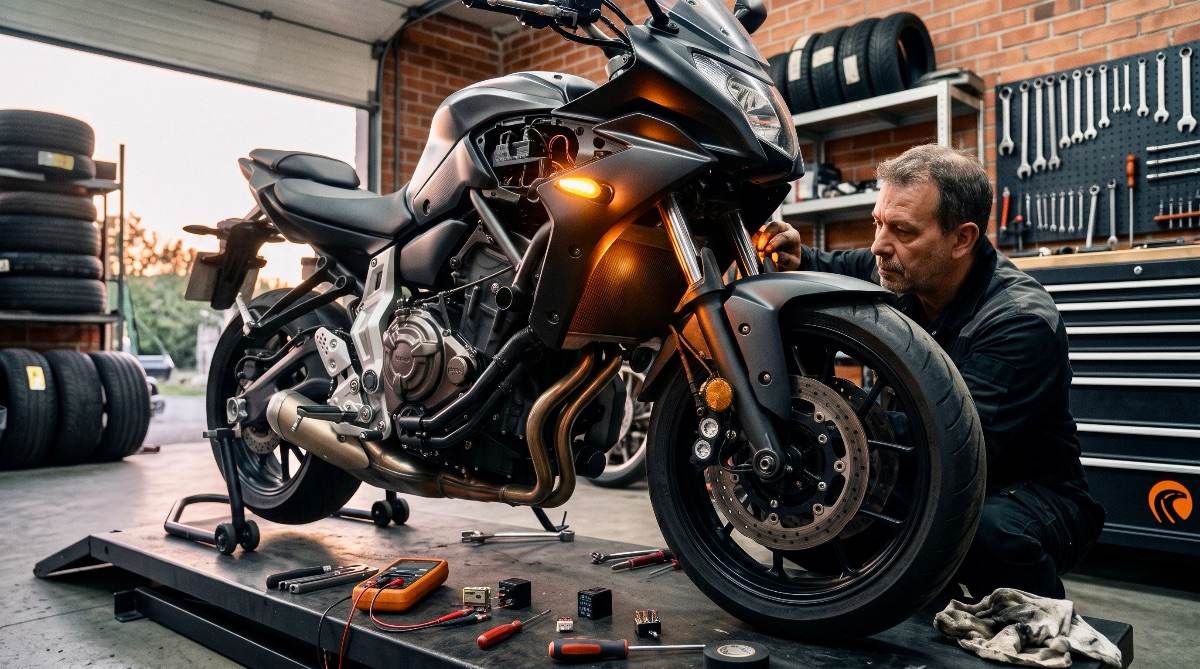
Changing classic bulb turn signals for smaller, more modern ones is, almost certainly, one of the first modifications we make when getting a new ride. The giant orange "paella pans" that many bikes come with from the factory completely ruin the bike's sharp aesthetic. But before you start cutting wires, the big question haunts every biker: will they pass the technical inspection (ITV)? Can I get a hefty ticket if the Civil Guard stops me? The short and direct answer is: yes, they pass the ITV, and no, you won't get fined, as long as you install legal motorcycle LED turn signals.
Installing bargain-bin accessories bought online that do not comply with Spanish regulations guarantees, almost 100%, that you will return home with an unfavorable sticker and a possible penalty. Below, we break down what current regulations require, how to install them so they work well, and where to find professional help.
How do I know if I have legal motorcycle LED turn signals?
It’s not enough for them to be super bright and beautiful. For the Civil Guard not to write you a ticket and for the inspection station to give you the green light, the turn signals must meet very strict requirements based on the General Vehicle Regulations and European standards.
The sacred E-Mark (European Homologation)
The number one requirement, and the one that fails you fastest in an inspection, is the lack of homologation. Each turn signal lens must have the European homologation code engraved on the plastic lens (or on the housing itself). This is easily identified by a capital "E" followed by a number, all inside a circle. The number indicates the European country that issued the homologation.
In addition to the letter E, the lens must include a number indicating the position for which it is homologated (for example, 11 for the front or 12 for the rear, although some are homologated for both with the code 11/12). If you mount Chinese lights that don't have this engraving, there is nothing to be done: it is a serious defect.
Position, separation, and visibility
The second point where many bikers fail is the position. Even if you have homologated lights, you cannot put them wherever you want. The General Vehicle Regulations require minimum distances.
As a general rule (although there are variations depending on the exact category of the vehicle), the minimum separation between the front indicators must be a couple of wide spans, and for the rear, the distance is slightly less, but always ensuring visibility. They must be at a symmetrical height relative to the ground.
For this reason, the famous turn signals integrated into the taillight itself, those embedded in the license plate holder too close to the center, or the famous micro-LEDs on the ends of the handlebars, usually cause problems. If the distance is not the regulatory one or the viewing angle from the sides is hidden by the exhaust or the luggage, the ITV will catch you. To be safe for the inspection, we recommend taking a look at preparing your bike for the ITV.
Common technical problems that don't pass the test
The annoying fast blinking (disco effect)
You bought your homologated lights, you respected the distance, and when you turn them on, they blink at the speed of light. Traditional halogen bulbs consume quite a bit of energy (usually about 10W or 21W). LEDs, on the other hand, consume barely 1W or 2W. The bike's original flasher relay detects this drastic drop in consumption and "thinks" a bulb has burned out, causing that hyper-fast warning blink.
The law requires the blinking frequency to be between 60 and 120 pulses per minute. If you exceed that speed, you will get a serious defect. You have two solutions:
- Install an electronic relay for LEDs: This is the most elegant and clean solution. You remove the original relay, put in the new one (which doesn't depend on consumption to set the pace), and that's it.
- Install resistors: These are placed in parallel on each turn signal to trick the original relay by emulating the consumption of the old bulb. They get very hot, so they must be anchored to the chassis, away from plastics.
If you are going to carry out this small modification and want to keep your annual expenses under control, you can always use our maintenance cost calculator to see if the workshop investment is worth it.
Is it considered a major modification?
According to the Vehicle Modification Manual, replacing bulb turn signals with LED technology is not considered a major modification, as long as (as we have insisted) the replacement is homologated, the geometry is respected, and they are installed in the original location.
If, to install your new LEDs, you have to cut the subframe, radically modify the original mounts, or remove the rear fender to put on a non-homologated short tail, you will be incurring a modification that does require a technical project. For those who are starting out and don't want trouble, it is vital to know what to choose for your first bike and avoid getting into extreme modifications on the first day. Also, many take this moment of disassembling plastics to modify other parts; always make sure to carry a homologated exhaust that passes the ITV.
Where to buy legal spare parts and install them with guarantees
If the whole electrical topic (cutting, splicing, using heat-shrink tubing, and calculating resistors) sounds like Greek to you, the best thing to do is go to professionals. Luckily, we have great options throughout the national territory.
To buy reliable and homologated parts, if you are in Asturias, Motos Garita in Oviedo is a spare parts store with a spectacular catalog. In case you need a trusted workshop in Bizkaia that can install the relay without doing a sloppy job on the wiring, stop by Motos Alex Sport.
If you are looking for a complete service in the northern area, ESPACIO MOTO S.L. in Gijón will advise you on both the purchase and legal accessories. In Barcelona, customization lovers have Automoto ilvi to find those minimalist LEDs that are so popular. And hey, if you leave the bike in Mallorca and have to wait, you can take the opportunity to catch up at Barbudo's inca while your machine gets shiny.
In case your budget is tighter or you are looking for original LED turn signals from other wrecked bikes, in Amorebieta-Etxano you can search the junkyard TAOH Motorecambios SL. After all, recycling is a great way to save, just like when you learn to sell used motorcycle parts quickly.
For the south, EmRider Motor Garage in Cádiz and Pirata Motos in Mairena del Aljarafe (Seville) are two comprehensive dealerships where you can ride out with your bike completely legal and modernized.
If you still have questions about mechanics or electronics, the community is always there. Stop by our biker forum with a mechanics section and ask other colleagues how they solved the fast blinking on your same bike model.
Changing your bike's lighting doesn't have to be a risky sport against regulations. Look for the E-mark, respect the separation, use a suitable relay, and enjoy a much more current and beautiful bike without fear of being stopped.
Activate ITV alerts in My Garage.
Este artículo y su imagen se han elaborado apoyándose en la inteligencia artificial y siendo revisados por el equipo de MotoCorner antes de publicarse. Las imágenes son ilustrativas y pueden no corresponder a modelos o piezas reales.