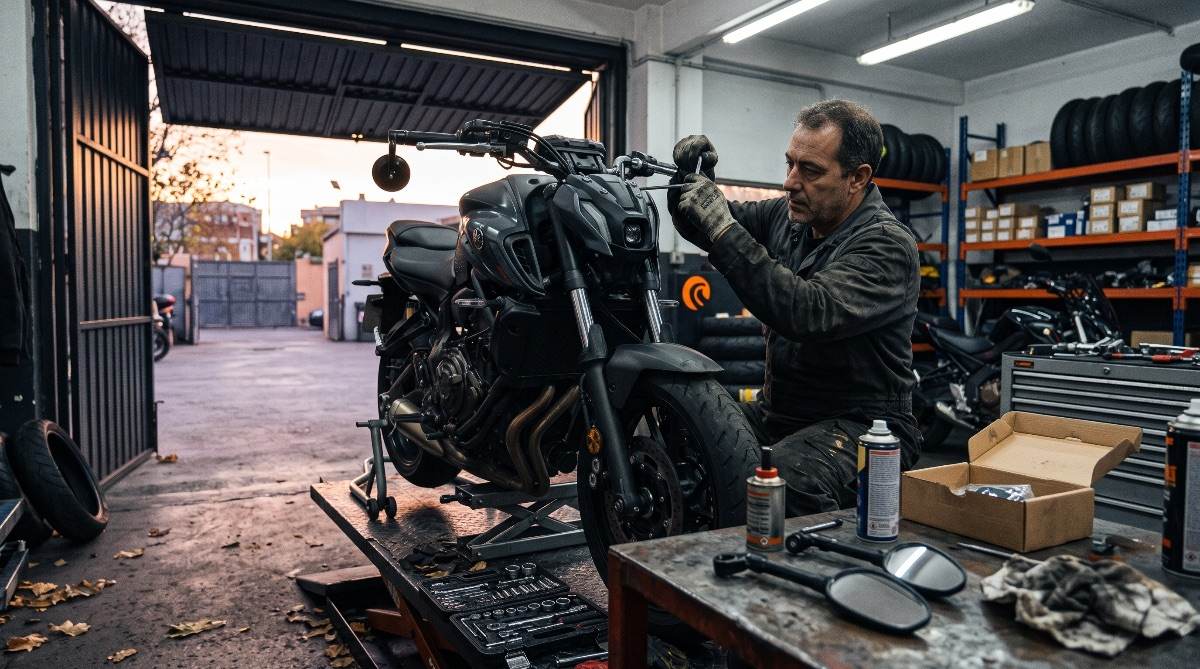
Motorcycle mirrors: which ones are mandatory and which ones will cause you problems at the ITV (MOT)
Will your new bar-end mirrors or mini models pass inspection? We tell you what the regulations say, how many are mandatory, and how to avoid unpleasant surprises.
Changing motorcycle mirrors is, almost certainly, one of the first aesthetic modifications we make after taking it out of the dealership. But when the time comes to go through the technical inspection station (ITV), the big question always haunts our minds: will I have problems with motorcycle mirrors at the ITV? And what if the Civil Guard stops me on a weekend ride for having very small or bar-end models?
The quick answer is that yes, you can pass the ITV and avoid fines with changed, bar-end, or customized mirrors, as long as they meet strict requirements: they must be correctly homologated, respect the minimum required number, have the legal field of vision, and not alter the dimensions on the technical data sheet. If you install tiny mirrors without the corresponding marking, or have cracked glass, the inspection result will be unfavorable and you could get a hefty fine on the road. Let's look at all this in detail.
How many mirrors are mandatory on your motorcycle?
In Spain, the General Vehicle Regulations are what govern this, and they establish the number of mandatory mirrors based mainly on the maximum design speed and the year of registration of your bike. The general rule is quite simple to remember:
- Mopeds (up to 45 km/h): Only the left mirror is mandatory. However, the right one is optional but highly recommended for your own safety.
- Motorcycles (over 100 km/h): It is mandatory to have both mirrors installed, the left and the right. Since the vast majority of motorcycles exceed this speed, assume you need the full pair.
- Old motorcycles (that do not exceed 100 km/h): The regulations mandatorily require the left one, with the right one remaining optional.
To avoid getting caught out by these technical details, it is always a good idea to review the current regulations on mandatory motorcycle equipment, as knowing your obligations will save you more than one headache.
What they check on motorcycle mirrors at the ITV
When you arrive at the inspection line, the technician will not just look to see if the mirrors "are there." There are several key points that they check exhaustively.
The blessed homologation (E-Mark)
It is commandment number one. Any mirror suitable for driving in Europe must have the homologation mark stamped on it. It usually appears as a capital letter "E" inside a circle or rectangle, followed by a number (which indicates the country that issued the homologation, for example, E9 for Spain) and a series of alphanumeric codes. If your mirrors lack this engraving, they will give you a serious defect directly.
Minimum surface and field of vision
The inspector will get on the motorcycle (or ask you to get on it) to verify that the field of vision from the riding position is adequate. European homologation already guarantees minimum reflective surface measurements. If you are just a few days away from your appointment, I suggest you take a look at our quick checklist for the ITV inspection to confirm that you haven't missed any visibility details.
Condition and mounting of the assembly
A homologated mirror is useless if it is hanging off. If the mirrors vibrate excessively, do not hold their position when adjusted, have broken glass, or the mounts are loose, the ITV will be unfavorable. Sometimes, excessive vibrations in the handlebar can indicate other underlying problems, so it never hurts to check the useful life of key parts of your motorcycle such as steering bearings or silentblocks.
Bar-end mirrors and mini mirrors: do they pass or not?
The aftermarket market is full of bar-end mirrors (those anchored to the handlebar weights) and the popular mini mirrors.
- Bar-end mirrors: They are perfectly legal and pass the ITV as long as they are homologated (have the E) and do not significantly increase the maximum width of the motorcycle indicated on your technical data sheet. If by mounting them outside the grips you make the motorcycle much wider than declared, the technician could consider it a modification.
- Mini mirrors: This is where most bikers fall short. 99% of ultra-small mirrors are not homologated because their surface does not meet the minimum legal area (to give you an idea, a circle of certain dimensions must be able to fit inside the glass). If they are too small, they do not pass the ITV, period.
Is changing mirrors considered a modification?
The Vehicle Modification Manual is the sacred text of the ITV. Fortunately, replacing mirrors with other homologated ones is not considered a modification, as long as they are installed on the vehicle's original mounts and the required number is respected.
However, things get complicated if you remove the stock fairing mounts to put some on the handlebar, or if, as we said before, you drastically modify the external dimensions of the vehicle. It is a scenario very similar to what happens when changing turn signals for LED models: the part may be legal, but its relocation or incorrect installation may require a homologation process via a technical project.
Fines on the road for having incorrect mirrors
Traffic authorities do not mess around. Driving without the mandatory mirrors, having non-homologated mirrors, or having them in a state of deterioration that makes their function impossible (such as shattered glass) is considered a serious offense. Although we will not go into the exact figures because regulations can be updated, you should know that the financial penalty stings, and they can fine you for each mirror that does not comply with the law. In addition, in the event of an accident, carrying non-homologated elements can cause you problems with your insurance company.
Conclusion
To ride with peace of mind and pass the inspection on the first try, the formula has no mystery: always buy mirrors with European homologation (E-Mark), make sure they offer a good viewing angle, tighten them well so they don't vibrate, and respect your bike's mounting points. Aesthetics are important, but seeing who is coming behind you when you are about to overtake can save your life.
So you don't miss the date of your next inspection and keep your bike perfect, activate the ITV alerts in My Garage and forget about last-minute surprises. Gas and happy riding!
Lleva el control de tu moto
Guarda tu moto en Mi Garaje gratis: avisos de revisión, ITV y seguro, y todos tus gastos en un sitio.
This article and its image have been created with the support of artificial intelligence and reviewed by the MotoCorner team before publication. The images are illustrative and may not correspond to actual models or parts.

Escrito y revisado por
Ariel Cervantes
Fundador de MotoCorner
Motero desde hace años, ha rodado con modelos y cilindradas muy distintos. Fundador de MotoCorner, combina esa experiencia sobre la moto con su trayectoria en producto digital para coordinar y revisar las guías de mantenimiento, rutas y herramientas para la comunidad motera.