2T oil in classic motorcycles: is the 5% requested by your Bultaco or Montesa manual still valid?
Discover what 2T premix oil ratio classic motorcycles need nowadays and why the 5% from old manuals is no longer the best option.
If you are lucky enough to keep a true two-stroke gem in your garage, you surely know that unmistakable smell of burnt premix that ignited passions in the seventies and eighties. To keep that engine running smoothly and bringing you many more joys, choosing the right classic motorcycle 2T premix oil is a fundamental step. However, when you open the original manual for your old mount, you find a recommendation that makes more than one mechanic raise an eyebrow today: 4% or even 5% mixtures.
Do you really need to pour that much oil into the tank nowadays? The short answer is no, but the long one has a lot of technical substance. Let's review why times have changed and how you should feed your classic so it runs perfectly without drowning in smoke.
Evolution of classic motorcycle 2T premix oil: from mineral to synthetic
When the legendary Bultaco, Montesa, OSSA, Puch, or Derbi models rolled off the assembly lines, the lubricant industry was very different. The oils of that era were mainly low-quality minerals. These lubricants had quite limited adhesion capacity and resistance to high temperatures. Therefore, to ensure the cylinder, piston, and crankshaft were well lubricated and wouldn't melt from friction heat, manufacturers played it safe by recommending a very high percentage: between 4% and 5%.
Today, lubricant technology has taken a giant leap. Modern oils for two-stroke engines are high-performance synthetic or semi-synthetic, meeting rigorous specifications such as JASO FD or ISO-L-EGD standards. These current lubricants have immense anti-friction power, leave far fewer residues, and lubricate optimally with much lower proportions. Continuing to use 5% with a state-of-the-art oil is not only a waste of money, but it can also be harmful to the mechanics. If you have doubts about the general state of your engine before adjusting the mixture, it is always advisable to find nearby motorcycle workshops that have specialists in vintage mechanics.
Risks of using too much or too little oil
The mixture of oil and gasoline in a two-stroke engine is the blood that gives it life, as there is no oil sump bathing the cylinder like in four-stroke engines. Finding the balance is vital.
The problems of using excess oil
If you decide to follow the 1975 manual and add 5% of current 100% synthetic oil, your bike will protest. The first symptom will be a dense white smoke from the exhaust pipe that will make it look like you are fumigating the neighborhood.
In addition to the smoke, the excess oil that does not burn correctly in the combustion chamber will generate carbon buildup. This black crust will accumulate on the cylinder head, the piston crown, and the exhaust port, choking the engine's performance. As if that weren't enough, you will end up suffering from the dreaded fouled or shorted spark plug, which will leave you stranded on the side of the road without a spark when you least expect it.
The terror of oil deficiency: seizing
Conversely, being too modern and dropping the mixture to 1% because "the oil is very good" can be a death sentence for the engine. If the lubricating film breaks due to a lack of oil, the friction between the piston and the cylinder liner will generate extreme heat.
The metals will expand until the piston literally gets stuck in the cylinder. This is the dreaded seizure, a catastrophic breakdown that involves opening the engine, re-boring the cylinder, changing the piston, and sometimes repairing the connecting rod and crankshaft. For this reason, adjusting the proportion requires knowledge and common sense. If you want to keep financial control of these potential repairs, it will be useful to estimate annual maintenance costs so you don't get any surprises.
Recommended proportions for Bultaco, Montesa, OSSA, and other classics
So, what percentage is appropriate today? As a general guideline, for Spanish classic motorcycles from the 60s, 70s, and 80s that are ridden on the street at normal paces, a good 100% synthetic oil (JASO FD) usually works wonderfully in proportions between 1.5% and 2%.
If you are going to push the engine in track sessions, hill climbs, or classic trials in very technical areas where the engine heats up with barely any air cooling, you can go up slightly to 2.5%.
However, these percentages are indicative ranges. The golden rule today is to always follow the indication marked by the oil manufacturer on the container, combined with the advice of your trusted specialist or your motorcycle's brand club. If you have specific questions about the carburetion of your model after changing the mixture, stop by our forum for two-stroke lovers, where other enthusiasts will be happy to help you.
How to make the mixture correctly
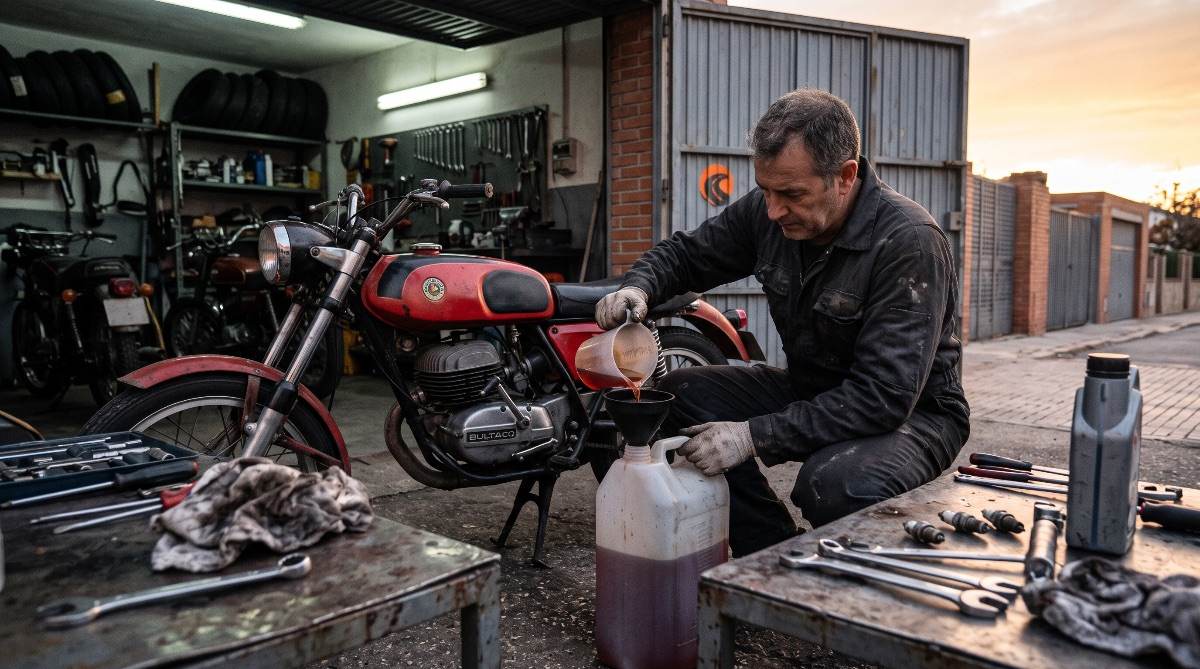
Another vital aspect is preparation. Although it can be a chore, the best way to make the mixture is in an approved external jug, never directly in the motorcycle's tank. Measure the exact amount of oil with a graduated cylinder, syringe, or measuring cup. Pour in the gasoline, add the oil, and shake the jug vigorously to ensure perfect dilution before filling the tank.
Remember that current gasoline, which contains ethanol, tends to degrade premix oil if it is stored for a long time. If you are not going to take your classic out for a ride for a long time, it is imperative to know how to protect your motorcycle during the winter, by emptying the carburetor and the tank to prevent gummy sediments from clogging the jets.
Taking care of a classic is a ritual that goes beyond mechanics. Once you have the engine tuned and burning the perfect proportion, you will also want to show it off at rallies. Dedicating a weekend to taking care of the aesthetics of vintage motorcycles by polishing chrome and reviving plastics will round out the experience of owning a historic machine.
In short, leave the 5% in the history books and adapt your classic's diet to modern times. The engine will run cleaner, the spark plug will last much longer, and you will enjoy every stroke without leaving a toxic cloud in your wake.
Add your classic to My Garage and keep track of the mixture, oils, and service intervals.
This article and its image have been created with the support of artificial intelligence and reviewed by the MotoCorner team before publication. The images are illustrative and may not correspond to actual models or parts.

Escrito y revisado por
Ariel Cervantes
Fundador de MotoCorner
Motero desde hace años, ha rodado con modelos y cilindradas muy distintos. Fundador de MotoCorner, combina esa experiencia sobre la moto con su trayectoria en producto digital para coordinar y revisar las guías de mantenimiento, rutas y herramientas para la comunidad motera.