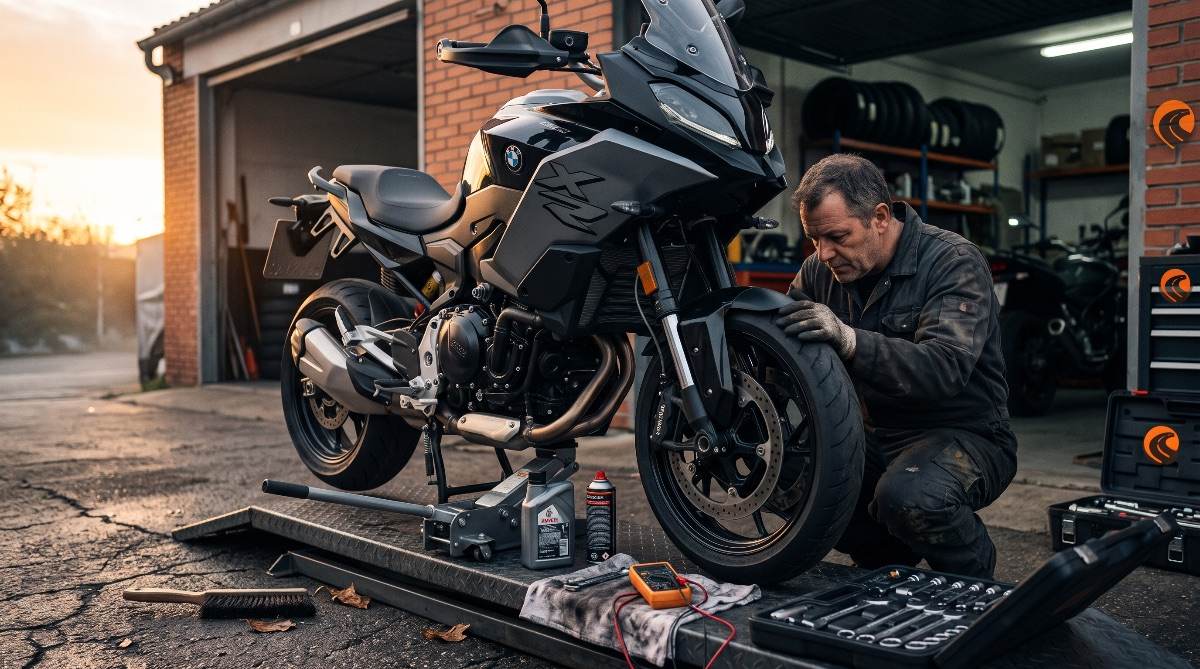
BMW F900R and F900XR maintenance guide
Discover the complete maintenance plan for the BMW F900R and F900XR (2020 onwards). Service intervals, tightening torques, consumables, and estimated costs.
Hello to all two-wheel enthusiasts! If you have landed here, it is very likely that you are the lucky owner of one of the most popular twin-cylinder bikes from the Bavarian brand, or that you are thinking about getting one. Since their launch in 2020, both the naked and the sport-touring versions have conquered Spanish roads, including their successful versions that can be restricted for the A2 license. Keeping up with the maintenance of the BMW F900R and its touring sibling, the F900XR, is vital for that 895 cc engine to always perform at the highest level.
In this article, we are going to break down everything you need to know to take care of your ride. Biker disclaimer: Remember that this guide is purely informative and is based on the official BMW Motorrad manuals. We are not the official dealership, so for any complex technical questions or if your bike is under warranty, always go to an authorized technical service.
F900R vs F900XR: Does the maintenance change?
Before we get down to business with the wrench, it is important to clarify what these two bikes share and what makes them different. The BMW F900R is a pure naked, with a more aggressive posture and shorter travel suspension. On the other hand, the F900XR is a sport-touring bike, with a front fairing, windscreen, longer travel suspension, and much more relaxed ergonomics for devouring kilometers.
However, mechanically, they are practically twins. Both mount the same 895 cc parallel-twin block (which produces 105 hp in its full version and 95 hp in the A2 version). They share the chassis, Brembo brakes, electronics, and chain drive. Therefore, the service schedule, consumables, and tightening torques are identical for both models from 2020 to the present.
BMW F900R and F900XR maintenance interval table
BMW Motorrad establishes a service schedule based on both mileage and elapsed time (whichever comes first). If you use the bike daily, you will reach the mileage sooner; if you only take it out on weekends, you will have to visit the workshop based on time.
Here is the official service schedule:
| Kilometers / Time | Main tasks to perform |
|---|---|
| 1,000 km (Break-in) | Engine oil and filter change. Chain slack check. Bolt check and electronic diagnostics. |
| 10,000 km / 1 year | Oil and filter change. Drive chain kit check. Brake pad and disc check. Brake fluid change (the first one at one year, then every 2 years). |
| 20,000 km | All of the above + Valve clearance check. Spark plug replacement. Air filter change. Fork oil check. |
| 30,000 km / 3 years | Standard maintenance (oil, filter, chain, brakes). |
| 40,000 km | Major maintenance: Oil, filter, valves, spark plugs, air filter, and exhaustive check of steering bearings and linkage. |
Note on the chain: Unlike classic BMWs with a shaft drive, here we have a chain drive. BMW offers the M Endurance chain (low maintenance) as an option, but if you have the standard one, you must clean and lubricate it every 500-1,000 km. If you have questions about the general wear of these elements, we recommend reading our article on when it's time to retire your bike parts.
Official consumables and capacities
For those of you who like to get your hands dirty in the garage (as long as the bike is out of warranty so as not to lose the official stamp), here is the technical data extracted from the BMW manual:
- Engine oil: A synthetic SAE 5W-40 oil that meets API SJ / JASO MA2 standards is recommended (BMW usually uses its own Advantec Ultimate brand). The capacity is approximately 3.0 liters with the filter change included.
- Oil filter: Check the exact reference in the manual or at your spare parts store, but it is usually a standard metal cartridge filter from the brand.
- Brake fluid: DOT 4. It is crucial to bleed the system well, especially if your unit has ABS Pro.
- Coolant: Ethylene glycol-based antifreeze (usually OAT) suitable for aluminum engines.
- Tire pressure (cold): 2.5 bar on the front wheel and 2.9 bar on the rear (standard for solo or passenger use, but always check the sticker on the swingarm).
Main tightening torques
If you are going to perform the maintenance yourself, using a torque wrench is not optional, it is mandatory. Over-tightening an aluminum crankcase is a very expensive breakdown. These are the most common tightening torques:
- Oil drain plug: 24 Nm (remember to always use a new copper/aluminum washer).
- Oil filter: 11 Nm.
- Rear wheel axle nut: 100 Nm.
- Front wheel axle nut: 50 Nm.
- Front brake caliper bolts: 38 Nm.
For chain tension, BMW specifies a slack of between 40 and 50 mm (measured at the lower midpoint of the chain, with the bike on the side stand and without load).
Indicative service costs in Spain
The price of maintaining a BMW is always a topic of debate. Although the F900R and the XR are entry-level models to the mid-high range, prices at the official service can vary significantly depending on the province. Here are some indicative ranges:
- Break-in service (1,000 km): Between €120 and €180.
- Annual or 10,000 km service: Between €150 and €250 (depending on whether the brake fluid needs changing).
- Major service (20,000 km / 40,000 km): Since it includes valve clearance and spark plugs, labor costs rise considerably. Estimate between €400 and €600.
To calculate your annual budget more accurately and keep track of your expenses, visit our motorcycle maintenance cost calculator.
Also, if you are comparing nakeds of this displacement before buying, you might be interested in taking a look at the Kawasaki Z900 maintenance guide to see the cost differences with its direct Japanese rival.
Electronics and service light reset
An important detail of the F900s is their spectacular color TFT screen. When it is time for service, the dreaded "SERVICE" warning will appear on the dashboard. Unlike older bikes, it cannot be cleared with a simple button combination. You will need a compatible OBD scanner (such as the MotoScan system) or visit a workshop that has a diagnostic machine to reset the interval.
Conclusion
The BMW F900R and F900XR are incredibly balanced, reliable, and fun machines. With rigorous maintenance, that twin-cylinder engine will give you joy for many years. If your bike is going to be parked in the cold because you prefer to ride only in good weather, see how to prepare and store your bike in winter so you don't get any surprises in the spring. And remember, any more specific mechanical questions can be asked in our biker forum.
Add your BMW F900R or F900XR to My Garage and receive notifications for each service.
This article and its image have been created with the support of artificial intelligence and reviewed by the MotoCorner team before publication. The images are illustrative and may not correspond to actual models or parts.

Escrito y revisado por
Ariel Cervantes
Fundador de MotoCorner
Motero desde hace años, ha rodado con modelos y cilindradas muy distintos. Fundador de MotoCorner, combina esa experiencia sobre la moto con su trayectoria en producto digital para coordinar y revisar las guías de mantenimiento, rutas y herramientas para la comunidad motera.