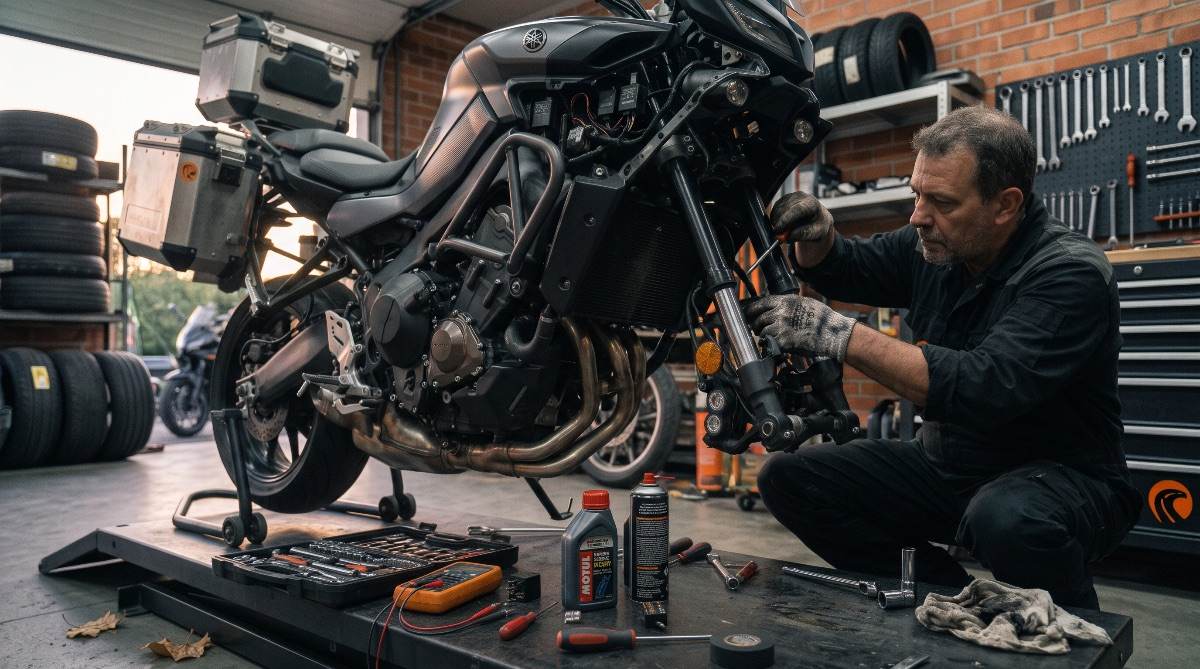
Yamaha Tracer 9 GT maintenance guide
Discover the complete maintenance plan for the Yamaha Tracer 9 GT (2021+). Learn about the intervals, capacities, estimated costs, and care for its electronic suspension.
If you are a die-hard mile-eater and are passionate about motorcycle touring without sacrificing sporty handling, you surely know how important it is to keep up with your maintenance. Today we focus on the Yamaha Tracer 9 GT maintenance, the quintessential three-cylinder sport-tourer that has won the hearts of thousands of riders in Spain. This guide covers models from 2021 onwards, equipped with the famous 890 cc CP3 engine block adapted to Euro 5, which includes the GT version and its particularities compared to the base model.
Since they share the same engine, many of the mechanical processes are identical to those we already detailed in the Yamaha MT-09 maintenance guide. However, the Tracer 9 GT includes specific elements, such as its iconic KYB semi-active electronic suspension, the lengthened swingarm, and a subframe prepared for luggage, which require special attention.
Below, we will review all the technical data from the official manual so you can take care of your riding companion as it deserves.
Official service intervals for the CP3
Yamaha establishes a fairly standard maintenance schedule for its 890 cc CP3 engine. Remember that you should always be guided by whichever milestone occurs first: mileage or elapsed time (months/years).
1,000 km service (Break-in)
This is the first and one of the most important. During the first stages of the engine, metal parts settle and can release small shavings.
- Oil and filter change.
- Chain adjustment and lubrication (the torque of the three-cylinder engine tends to stretch the chain at the beginning).
- General bolt check and electronic throttle (Ride-by-Wire) play check.
Minor services (every 10,000 km or 1 year)
Every time the odometer adds ten thousand kilometers, your Tracer will ask you to head to the pits for basic routine maintenance:
- Engine oil: Mandatory replacement.
- Oil filter: Yamaha recommends changing it at every service.
- General check of brakes, coolant, and condition of the chain kit.
- Visual inspection of tire condition and pressure, something vital on a bike intended to ride with luggage and a passenger.
Major services (every 20,000 km and 40,000 km)
This is where the bill usually goes up a bit more.
- At 20,000 km: In addition to oil and filter, it is time to change the spark plugs (use the NGK LMAR9A-9 specified by Yamaha) and check or replace the air filter. On the Tracer 9, changing the air filter requires removing the tank plastics, so be patient if you do it yourself.
- At 40,000 km: The long-awaited (and feared) valve clearance adjustment is performed. The CP3 engine is very reliable, but due to its high revs, it is crucial to check the clearances and change the shims if they are out of tolerance. It is also recommended to change the coolant every 3 years, and the rubber brake hoses every 4 years.
Consumables and capacities of the Yamaha Tracer 9 GT
If you like doing things yourself in your garage, these are the official data for the Tracer 9 GT (890 cc) from 2021 onwards:
- Engine oil: SAE 10W-40 (the brand usually recommends Yamalube, but any superior quality API SG and JASO MA2 oil will work).
- Oil capacity: Approximately 3.2 liters if you change the filter, and 3.0 liters if you only change the oil.
- Coolant: Around 1.93 liters in the radiator and hoses, plus 0.25 liters in the expansion tank.
- Brake fluid: DOT 4.
- Drive chain slack: Between 35 and 45 mm, measured at the bottom center of the chain (with the bike on the side stand and unloaded). Important! Do not overtighten it, as the geometry changes drastically when a passenger and luggage are added.
Main tightening torques
Using a torque wrench is non-negotiable, especially if you are going to handle safety parts or aluminum crankcases. Note: Always check your workshop manual in case there are variations from year to year, but these are the standards for the 890 cc engine:
- Oil drain plug: 43 Nm.
- Oil filter: 17 Nm (or two turns from when the rubber gasket makes contact, with prior lubrication).
- Rear wheel axle: 105 Nm.
- Front wheel axle: 65 Nm.
- Front brake caliper bolts: 35 Nm.
Electronics and semi-active suspension (KADS)
What makes the GT special compared to the standard Tracer is the KYB Actimatic Damper System (KADS) suspension and, in the case of the GT+, the adaptive radar.
In terms of user maintenance, there is not much to touch on the KADS suspension beyond keeping the fork tubes clean and periodically checking that there are no oil leaks at the seals. However, when it comes to changing the fork oil (recommended every 20,000-30,000 km to avoid losing efficiency in the semi-active system), the process is much more complex.
It requires bleeding the solenoid valve system and specific tools. For this step, we strongly recommend looking for trusted workshops specialized in electronic suspensions or going to the official network. If you get any error code on the TFT screen related to the suspension, do not hesitate to share mechanical questions on our forum before getting alarmed, as sometimes it is just a software update or calibration required.
Indicative costs of Yamaha Tracer 9 GT maintenance
How much does it cost to maintain this sport-tourer? Unlike more exotic bikes, Yamaha has quite reasonable maintenance costs, although since it is a bike full of technology, it doesn't hurt to know what price range we will find in Spain.
- Annual or 10,000 km service: Usually ranges between €140 and €220, depending on the workshop's labor, as it mainly includes oil, filter, and visual checks.
- 20,000 km service (Filters and spark plugs): Calculate between €250 and €350. The CP3 spark plugs are not excessively expensive, but labor increases due to the need to remove parts of the fairing and tank.
- 40,000 km service (Valve adjustment): This is the most painful for the pocket. As it is a modern three-cylinder with little access space, labor skyrockets. The cost can range between €450 and €700, and even more if many valves need to be adjusted and fluids, chain kit, or brake pads also need to be changed in the same service.
If you want to keep exact financial control so you don't get surprises at the end of the month, we recommend estimating annual workshop costs with our free tool, where you can configure mileage and gasoline price.
Conclusion
The Tracer 9 GT is an exceptional machine designed to devour curves and continents alike. Its CP3 engine is as fun as it is reliable, but its sporty character requires you to be meticulous, especially with chain tension and oil condition. On the other hand, the electronics it incorporates sometimes require official diagnosis, but in return, it gives you one of the safest and most comfortable rides on the market.
So that you never miss an important date or a filter change, we have the perfect solution within our platform to manage your motorcycle's services in a simple and centralized way.
Add your Yamaha Tracer 9 GT to My Garage and receive notifications for each service.
Este artículo y su imagen se han elaborado apoyándose en la inteligencia artificial y siendo revisados por el equipo de MotoCorner antes de publicarse. Las imágenes son ilustrativas y pueden no corresponder a modelos o piezas reales.