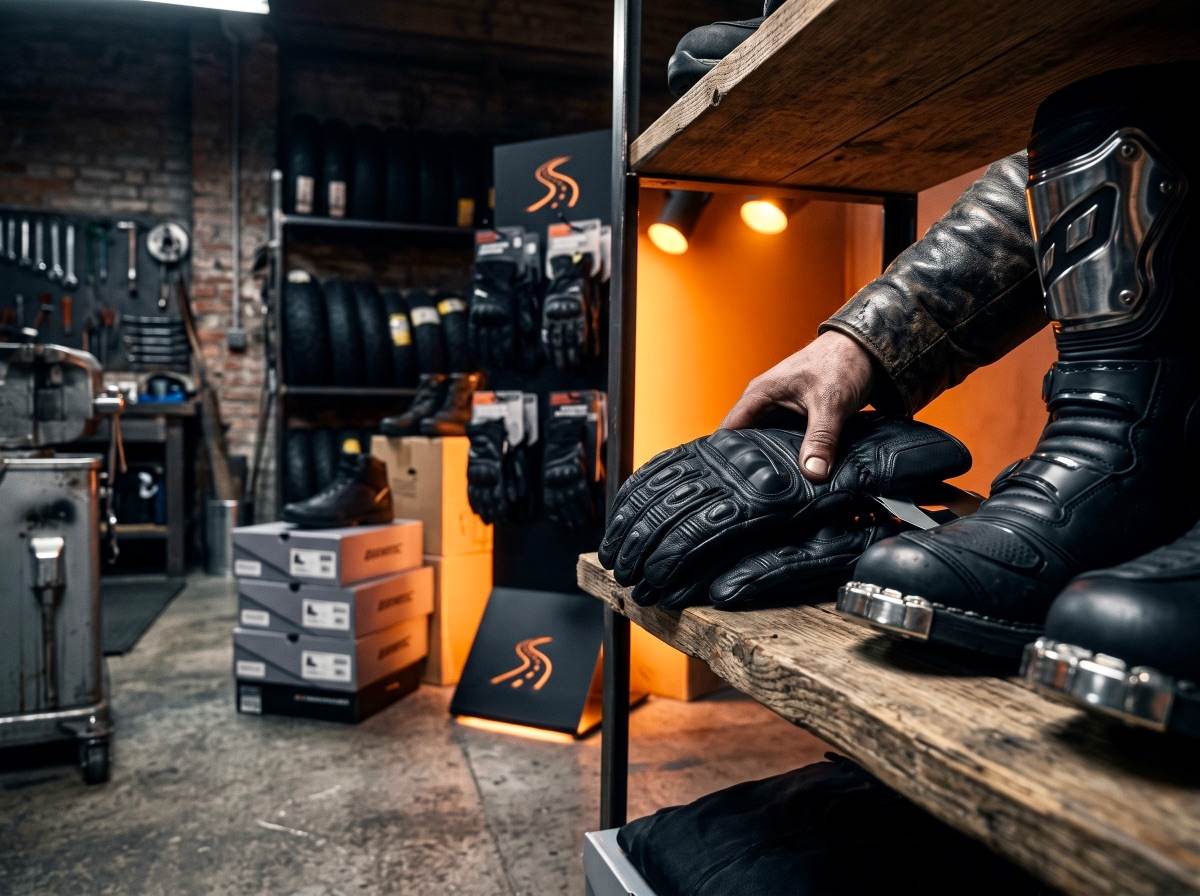
New DGT rule for gloves and footwear from October 1st: how to prepare your store
From October 1, 2026, gloves are mandatory on the road and closed-toe footwear on all roads. How to adapt your motorcycle business stock and advise your customers well.
October 1, 2026, marked a turning point for motorcyclist safety on our roads. With Royal Decree 518/2026, the Directorate-General for Traffic (DGT) has made the use of protective gloves on interurban roads (for both rider and passenger) and closed footwear on all types of roads mandatory—a long-debated measure that is now in effect. For the end user, this represents a vital improvement in passive safety, but for your business—whether it's a local workshop, an official dealership, or an accessory boutique—it represents a commercial and loyalty-building window you cannot afford to miss.
Preparing your store for this regulatory change isn't just about filling your warehouse with boxes of gloves and boots. It requires an advisory strategy, supplier reviews, and technical product knowledge. In this regard, brands have been preparing for years; for example, benchmarks like Alpinestars SE have developed extensive lines of urban and touring products with certifications that, until now, were only "highly recommended."
Know the regulation thoroughly to be the expert your customer needs
The first step to selling is informing correctly. Many motorcyclists who use their vehicle exclusively for urban travel (to get to work or move around the city on a scooter) are usually the most reluctant to gear up from head to toe. They are primarily affected by the footwear requirement, and by gloves as soon as they hit the open road.
Your sales or counter team must know how to explain exactly what the law requires, because there is a lot of confusion:
- Gloves: Mandatory on interurban roads (highways, dual carriageways, and motorways), not in the city. The ministerial order that will establish which technical standard they must meet has not yet been published, so for now, any protective gloves will suffice. The most honest approach is to recommend gloves certified according to EN 13594, the most likely reference once the order is published.
- Footwear: Must be closed and cover the entire foot, on any road. The law does not require it to be homologated, but footwear certified according to EN 13634 is what truly provides protection.
- Fine: 200 euros (100 with early payment) for each violation.
If you or your employees need to refresh your knowledge, you can always check the DGT regulations on mandatory equipment to have the legal details on hand when facing buyers' questions.
Stock review: beyond winter gear
The fact that the regulation comes into effect in October coincides with the usual change of the biker's wardrobe, which facilitates the sale of mid-season and winter products. However, the real logistical challenge for your inventory will come when customers look for urban and discreet gear.
Not everyone wants to look like a racing pilot to go to the office. You must ensure you have:
- Lightweight but certified urban gloves: Those that offer knuckle protection and abrasion resistance without compromising feel or comfort.
- Certified casual-style sneakers: Footwear is the big battleground of this regulation. The scooter user needs boots or sneakers that look like street shoes but feature reinforcements in the ankle, toe, and heel.
- Clear and visible labels: Make sure your customers understand what they are buying. It is an excellent time to educate them on the guide to materials and CE labels, explaining the difference between protection levels 1 and 2.
- Reflective vests: The same reform includes them in the mandatory equipment for motorcycles. It is a small sale, easy to place at the checkout.
How to take advantage of the regulation according to your business type
The arrival of this regulation impacts the entire sector transversally, and each type of business can adapt its sales pitch in a unique way by relying on its specialty. At MotoCorner, we see daily how different professionals approach these opportunities.
Accessory stores and boutiques
For pure equipment stores, like Automoto ilvi in Barcelona, this is the time to adapt window displays and give maximum visibility to glove and boot areas. Creating "Mandatory Urban Gear" zones facilitates quick purchases for customers who come in a hurry looking to comply with the law, allowing your salespeople to upsell to products of higher quality, comfort, or waterproofing.
New and used vehicle dealerships
If you are in the business of selling motorcycles, the vehicle delivery is the critical moment. Comprehensive businesses like Kawasaki Cádiz or EmRider Motor Garage have the opportunity to offer "Legal Safety Packs" with the purchase of the bike. Handing over the keys to the bike along with the proper advice not only ensures the customer rides away legally, but also reinforces your professional image. This equipment advice fits perfectly when you explain to the buyer the essential care during the break-in period, creating a 360-degree sales experience.
Mechanical workshops and spare parts dealers
You might think a workshop has no say in equipment sales, but you would be missing a golden opportunity. The mechanic is, by definition, the professional the biker trusts the most. Workshops that prioritize direct interaction, such as Motozona Aljarafe in Seville, Tecnomoto Córdoba, Motos Tapia in Álava, or MOTOKASS in Arévalo, know that a casual chat while tightening the chain can lead to a sale. Even in spare parts businesses like Motorecambios y Desguace de Moto (Piedralaves), informing the customer at the counter about the new DGT fines adds value to your service and shows that you care about them beyond the part they came looking for.
Digital strategy and omnichannel visibility
Today's biker searches on their phone before stepping into your shop. Therefore, your digital presence this season must be impeccable and transparent. Many businesses make the mistake of hiding prices to force a call, but in today's digital era, putting "price upon request" no longer works. The customer looking for certified sneakers to avoid a fine wants to know how much they will cost before going to your store.
To maximize your reach in your area, use your digital storefront to highlight your best digital products. If you have a good assortment of seasonal gloves, upload them. Users of our community continuously use the unified motorcycle and equipment search engine to locate sizes and models near their location; if your stock is updated, you will be the answer to their search.
Likewise, consider creating specific campaigns. Autumn is the ideal time to publish offers and discounts aimed at clearing out last season's stock of gloves that have certification, thus attracting price-sensitive customers who are only looking to avoid the DGT sanction.
Conclusion: Transform an imposition into a value-added service
The new DGT regulation on gloves and footwear is not a mere administrative procedure; it is a necessary evolution in the safety of our sector. As a motorcycle professional, your role is fundamental in ensuring this transition is smooth for the user. Anticipate questions, structure your stock with daily comfort in mind, and communicate clearly and honestly, without selling as "mandatory" what is not yet so.
Those businesses that know how to position themselves as trusted advisors, offering practical and certified solutions instead of just trying to sell the most expensive item, will be the ones that succeed in building loyalty among that huge pool of urban motorcyclists who now, by necessity, will have to gear up properly.
Featured Recommendation
Limited Edition · Alpinestars marTHAInator (Jorge Martín)
The Alpinestars S-R10 marTHAInator LE helmet combines 4Impact technology with Jorge Martín's official design. Very limited units for the SP26 season.
How we write this article
- We start from reliable documentation: manufacturer owner's manuals and maintenance schedules, official Spanish regulations (BOE and DGT) and public registration data.
- Artificial intelligence helps us organise and summarise that documentation. The text and image were produced with its support.
- Before publishing, the MotoCorner team checks the key figures (oils, pressures, intervals, legal requirements).
Images are illustrative and may not match real models or parts. Always check your motorcycle's manual.

Written and reviewed by
Ariel Cervantes
Founder of MotoCorner
A long-time motorcyclist, Ariel has ridden many different models and engine sizes. As MotoCorner’s founder, he combines his riding experience with his digital product background to coordinate and review maintenance guides, routes and tools for the motorcycle community.
Technical review: data checked against official manufacturer documentation and current regulations.