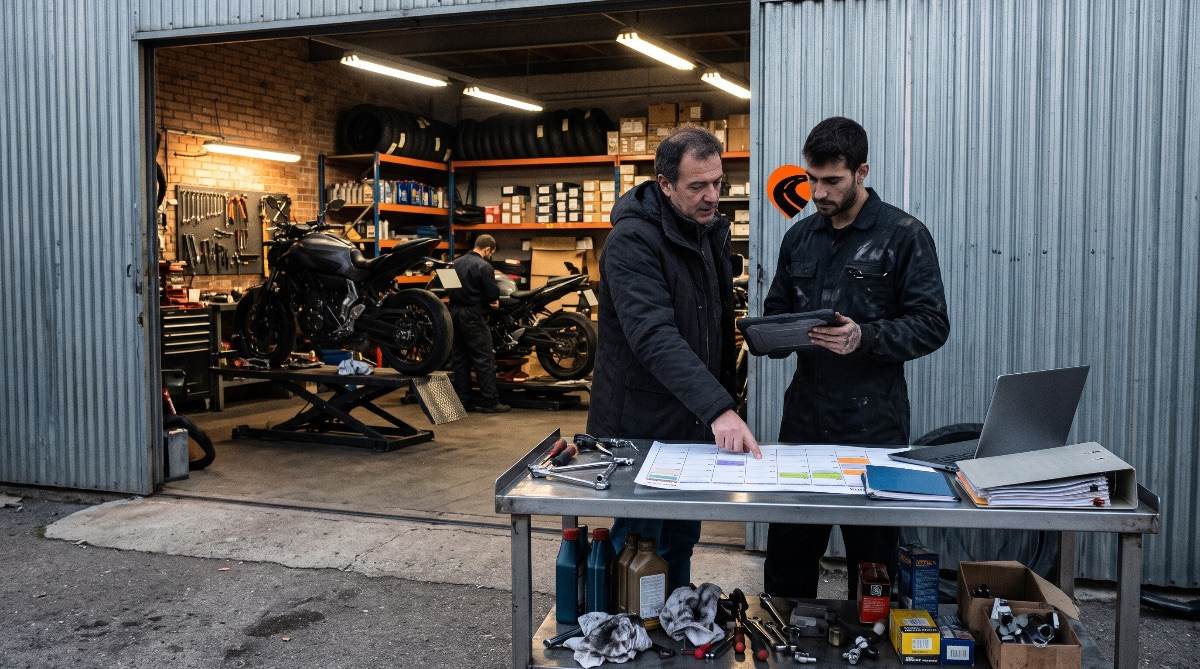
Organize the day-to-day workshop operations: appointments, work orders, and timing.
Discover how to optimize your motorcycle workshop management: from scheduling and repair times to inventory control to avoid bikes sitting idle on the lift.
The sound of engines, the smell of gasoline, and the feel of tools are the essence of your business, but if internal management fails, stress can end up ruining your passion for mechanics. Knowing how to organize a motorcycle workshop is the key that separates a chaotic business, where customers are always calling to ask about their vehicle, from a profitable, efficient repair center that conveys confidence from the very first moment the bike walks through the door.
In this article, we are going to review how to structure your day-to-day so that work flows constantly. We will talk about how to manage the schedule, how to document each intake, and how to set times so that lifts are never occupied by vehicles waiting for parts.
Keys to organizing a motorcycle workshop: appointment planning
The biggest mistake in a workshop reception is giving appointments blindly or accumulating all drop-offs first thing in the morning. For the day to be productive, you need to classify your schedule slots according to the type of intervention.
Reserving space for a quick check-up is not the same as opening a complete engine. Divide your daily capacity by combining long jobs with short interventions, so that there is always fast billing flowing. In addition, it is essential to always leave a small buffer of time for unforeseen events or emergencies. That loyal customer who arrives with a flat tire on the way to work will greatly appreciate it if you can make room for them.
If you manage to stabilize this vehicle intake, you will have gained a lot of ground when it comes to planning for the slower months, ensuring that your business remains profitable even when the cold keeps bikers off the asphalt.
The work order: your legal and operational lifeline
A motorcycle should not step into the work area without a clearly written work order (WO). This document is not just bureaucracy; it is the map that guides the mechanic and the contract that protects you against any misunderstanding with the customer.
The order must always include the full details of the owner and the motorcycle (license plate, model, mileage, and fuel level). But the most important thing is to detail the symptoms or the requested work exactly. Never put "check noise"; specify "check metallic noise in the clutch area when downshifting while hot."
Get into the habit of taking photos of the general condition of the motorcycle at the time of reception. If there is a previous scratch on the fairing or a broken turn signal, it must be reflected and signed by the customer. This will avoid unfair claims at the time of delivery.
Standard times per intervention: indicative ranges
To be able to give appointments with precision, your team must know the average times for each operation. Although every model is a world of its own and the plastics of some modern scooters seem designed to test your patience, you can establish indicative ranges to calculate your quotes and your schedule.
For example, an oil and filter change on a standard naked bike should be around 30 to 45 minutes. Replacing brake pads usually takes 20 to 40 minutes per axle, depending on whether it requires deep cleaning of the pistons. In the case of tire changes, a well-equipped professional usually spends about 45 minutes for both axles, while a complete service with valve adjustment can easily take 2 or 3 hours or more, depending on engine access.
Reception and delivery: the customer experience
The moment of picking up and returning the motorcycle is the only part of your work that the customer actually sees. Use a visual checklist at reception: check lights, tire condition, chain slack, and basic levels in their presence. This not only builds trust, but often allows you to detect small extra maintenance tasks that the customer had not noticed.
At the time of delivery, always meet the promised time. Explain clearly and without unnecessary technical jargon what has been done to the motorcycle and show them the old replaced parts if possible. Encourage them to use digital tools to manage their next maintenance, which will help them remember when it is time to visit you again.
Avoid the motorcycle graveyard: spare parts and stock
There is nothing that sinks productivity more than a disassembled motorcycle occupying a lift because a gasket or a bearing is missing. The golden rule is clear: order the spare parts the moment the customer confirms the appointment and pays the deposit, never when the motorcycle is already in the workshop.
Always have a minimum safety stock of the consumables with the highest turnover: oils of the most common densities, brake fluids, contact cleaners, and tire weights. Optimizing this aspect will also allow you to save on the purchase of spare parts by placing bulk orders instead of making urgent last-minute purchases. If, upon disassembly, you discover that an unforeseen part is needed that will take days to arrive, notify the customer immediately and remove the motorcycle from the lift to continue producing.
Collaborations and professional contact network
No workshop is an island. Part of good organization is knowing how to delegate or find the exact part in record time by relying on a good directory of motor professionals nationwide. If you get overwhelmed or a very niche project comes in, it is vital to have professional colleagues or reference specialists.
Working in a network and taking care of your reviews is also a fantastic way to improve your business positioning, attracting customers organically through digital word-of-mouth.
An immaculate workstation
Finally, mental organization begins with the physical space. When finishing each motorcycle, the mechanic must spend a few minutes cleaning the lift, putting away tools, and cleaning up any liquid spills. A misplaced wrench is time wasted looking for it during the next repair.
An orderly workshop is noticeable at every delivery: start this week with just one change and measure how much time it saves you.
This article and its image have been created with the support of artificial intelligence and reviewed by the MotoCorner team before publication. The images are illustrative and may not correspond to actual models or parts.

Escrito y revisado por
Ariel Cervantes
Fundador de MotoCorner
Motero desde hace años, ha rodado con modelos y cilindradas muy distintos. Fundador de MotoCorner, combina esa experiencia sobre la moto con su trayectoria en producto digital para coordinar y revisar las guías de mantenimiento, rutas y herramientas para la comunidad motera.